Science Lab Furniture for K-12 Schools: The Complete Spec Guide
Posted by Today's Classroom Team on 4th Aug 2026
8–12 wks
Custom casework lead time
$400–$800
Per linear foot, epoxy resin bench
20+ yrs
Lifespan of SEFA 8 lab casework
55 ft
Max eyewash station distance (OSHA)
A high school in Texas opened a new chemistry lab in September. The district had saved money by ordering HPL-surface lab tables instead of epoxy resin. They looked identical in the product photos. The lab teacher flagged it before the order went out. Nobody listened.
By February, three table surfaces had permanent chemical stains from titration experiments. One had bubbled and lifted. Replacing three lab benches mid-year in an active chemistry lab cost more than the savings from the original spec decision.
Furnishing a science lab for K-12 schools is not like furnishing any other room in the building. The consequences of the wrong choice are chemical, structural, and, in some cases, involve your district's safety liability. This guide gives you the framework to get it right before anything ships. For how the science lab fits alongside the other rooms in a K-12 build, see the room-by-room school furnishing guide.
In this article
- Why science labs are the highest-stakes room to furnish
- The surface material decision
- Lab bench configurations
- Storage, safety stations, and code requirements
- Which brand fits which build
- What a science lab build actually costs
- Frequently asked questions
Why science labs are the highest-stakes room to furnish
Every other room in a K-12 building can absorb a wrong furniture decision. You ordered the wrong desk height, you swap it out. You chose the wrong rug size, you return it. The consequence is administrative.
In a science lab, a wrong furniture decision creates a hazard that operates quietly for months. A surface that cannot resist the chemicals being used does not fail dramatically. It fails gradually. Stains appear. Surfaces bubble. Laminate edges lift and collect residue. By the time it is visible, the damage is done.
| What Makes It Different | What Goes Wrong | The Consequence |
|---|---|---|
| Surface material is a safety spec | Wrong surface cannot be decontaminated after a spill | Safety liability plus full replacement cost |
| Furniture must align with utilities | Bench positioned off a utility drop | Sink that does not drain, gas line that cannot connect |
| Longest lead times of any room | Order placed in August for September opening | Lab opens empty |
That third row is the one most buyers underestimate. Custom science lab casework takes 8 to 12 weeks from order to delivery. For a September opening, the purchase order needs to go out by June 1 at the latest. Our guide on why school furniture orders go wrong covers the pre-order decisions that catch timeline and specification problems before they become emergencies.
The surface material decision: what each option actually means
This is the most consequential specification in a science lab build. The right surface follows the course catalog, not the grade level and not the budget.
| Surface | Right For | Chemical Resistance | Never Use For |
|---|---|---|---|
| Epoxy Resin | High school and college chemistry | Nitric acid 70%, HCl 20%, H2SO4 60% | K-8 general science (overspecified) |
| Phenolic Resin | Biology, physics, earth science | Moderate chemical exposure, moisture | AP chemistry (underspecified) |
| HPL | K-8 general science only | Basic cleaning agents only | Any secondary chemistry lab |
What SEFA 8 actually tests
SEFA 8 is the published standard from the Scientific Equipment and Furniture Association for laboratory-grade casework. It tests hinge durability, drawer load capacity, shelf strength under heavy equipment, and chemical resistance of finishes under 24-hour exposure to common lab chemicals. A surface that passes SEFA 8 chemical testing will not bubble or peel from the compounds your students are using. A surface that does not carry SEFA 8 certification has not been independently tested for that.
The HPL mistake
HPL looks identical to phenolic resin in product photos and costs significantly less. In a working chemistry lab, it fails within three to five years. By the time the surface bubbles and lifts, replacement means dismantling an active lab mid-semester. The savings from the original spec decision rarely cover the cost of early replacement.
The course-based decision rule
Ask one question before specifying any surface: what chemicals are being used in this room?
- ●If the answer includes any concentrated acids, bases, or solvents: epoxy resin.
- ●If the answer is biological reagents, moderately corrosive materials, or moisture only: phenolic resin.
- ●If the answer is vinegar, baking soda, water, and food-safe materials: HPL.
A fourth-grade science room does not need epoxy resin. An AP chemistry lab cannot use HPL. The course content determines the spec. Everything else is noise. Our sibling guide on how to set up an elementary school classroom covers the general science furniture that fits K-5 rooms without epoxy specifications.
Not sure which surface your lab needs? Describe what is being taught and our team confirms the right specification before the order goes out. No guessing. No February surprises. Call 877-909-9910.
Get Free Surface Spec ReviewLab bench configurations and when each one works
The surface material gets the most attention in a lab build. The bench configuration determines how many students the room serves, how utilities are routed, and whether the room can shift between lecture and lab mode. It gets far less attention than it deserves.
Perimeter benches
Benches run along the walls with the center of the room open. This is the right configuration for demonstration-heavy teaching where the teacher needs unobstructed sightlines across the room.
Works well for classes of 16 to 20 students. Scales poorly beyond 20 because wall space runs out before seating capacity is met.
Island benches
Freestanding bench units in the center of the room, with students seated on both sides. This is the standard configuration for larger chemistry and biology labs serving 24 to 30 students simultaneously.
Each island seats six to eight students. The teacher circulates the full room without crossing in front of any student's workspace. Utility drops for gas, water, and electricity run through the bench pedestal from connections below the floor or ceiling.
Utility alignment is critical for island benches
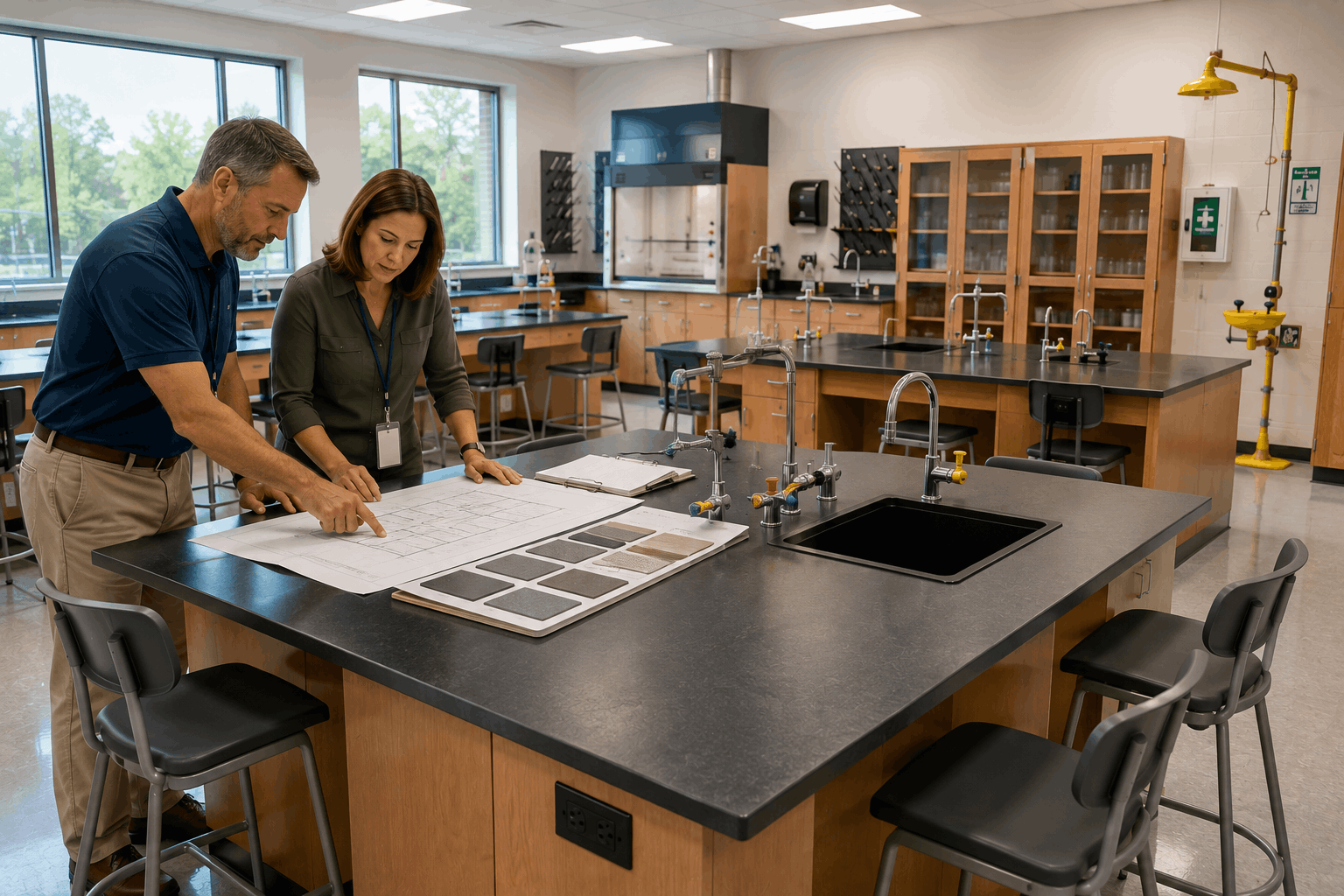
If the bench position shifts even a few inches after the utility rough-in is complete, the connections do not line up. A sink that does not drain or a gas line that cannot safely connect is a construction problem that lands on the furniture budget to fix. TC's Project Team aligns every bench position with the utility layout in a 3D rendering before anything is ordered. That step costs nothing. Fixing a misaligned utility connection after delivery costs thousands.
Peninsula benches
Benches attach to the perimeter wall on one end and extend into the room as a peninsula. They combine the utility routing convenience of a perimeter setup with more student seating capacity. Right for labs serving 20 to 24 students without the full utility infrastructure of island benches.
Mobile science workstations
For schools that run the same room across multiple grade levels throughout the day, mobile workstations on locking casters give teachers the flexibility to reconfigure in minutes. A teacher can set up seventh-grade earth science in the morning and AP chemistry in the afternoon with completely different bench arrangements.
The tradeoff: mobile workstations do not support under-bench plumbing and gas connections. They work for electrical-only setups or portable water delivery. For full chemistry labs with plumbing and gas, fixed casework is the correct specification.
| Configuration | Best For | Student Capacity | Utility Support |
|---|---|---|---|
| Perimeter | Demonstration-heavy teaching | 16 to 20 | Wall-mounted connections |
| Island | Large chemistry and biology labs | 24 to 30 | Under-floor or ceiling drops |
| Peninsula | Mid-size labs, moderate utility needs | 20 to 24 | Wall-mounted connections |
| Mobile workstations | Multi-grade rooms, flexible use | Variable | Electrical only |
Browse fixed and mobile configurations at lab and workstations to compare options across all four setup types.
Utility layout before the order. Today's Classroom Project Team works with your facilities manager to align every bench position with your plumbing and gas drops. Utility collisions get caught in the 3D rendering phase, not after delivery. Call 877-909-9910.
Start Your Free Lab LayoutStorage, safety stations, and what the code requires
A science lab is not fully furnished until the storage and safety infrastructure are in place. These are the items most often left off the first order and the most expensive to add later.
Chemical storage: NFPA 30 is not optional
NFPA 30-compliant flammable storage cabinets. This is a code requirement. Standard under-bench cabinets do not meet it, regardless of how they are labeled. NFPA 30 cabinets have double-wall steel construction, self-closing doors, and ventilation provisions that prevent vapor accumulation. Standard cabinets do not.
| Storage Type | What It Handles | NFPA 30 Compliant |
|---|---|---|
| Standard lab cabinet | Glassware, non-reactive materials, equipment | No |
| NFPA 30 flammable storage cabinet | Solvents, fuels, flammable reagents (acetone, ethanol) | Yes, required |
Lab storage at Today's Classroom includes both standard laboratory storage and NFPA 30-compliant options. Our guide on how to choose classroom storage for schools covers the placement and configuration decisions that apply across every room type, including labs.
Eyewash stations: the 10-second rule
OSHA requires eyewash stations to be accessible within 10 seconds of travel from any point where a corrosive chemical is used. In a standard walking pace, that is approximately 55 feet. If any student workstation is more than 55 feet from an eyewash station, the layout fails the requirement regardless of how well the benches are specified.
The layout error nobody catches until inspection
The furniture is ordered correctly. The eyewash stations are installed correctly. But the bench configuration puts certain student positions 60 feet from the nearest eyewash. The layout fails the OSHA requirement. TC's Project Team maps safety station positions alongside bench positions in every lab layout. That is the only way to confirm compliance before the furniture ships.
Demonstration tables and clean-up sinks
Demonstration tables and clean-up sinks are a specific product category built with the same surface specifications as the student benches. A standard classroom table with a basin added does not meet the chemical exposure requirements of a working lab.
Which brand fits which budget and build type
Three brands cover the full range of K-12 science lab builds. The right one follows the project type and timeline, not personal preference.
| Brand | Best For | Lead Time | Key Differentiator |
|---|---|---|---|
| Sheldon Labs | New construction, 30-year permanent builds | 10 to 14 weeks | Motorized benches, utility-integrated casework, Axis Infinity line |
| Diversified Spaces | Standard renovations, all surface types, institutional quality | 6 to 8 weeks | SEFA 8 compliant, versatile, proven across all K-12 lab types |
| National Public Seating | Mid-year additions, tight budget, fast timeline | 2 to 4 weeks (Quick Ship) | 10-year warranty, steel or oak frames, best price-to-durability ratio |
Sheldon Labs: the 30-year build
Sheldon Labs is the premium specification for districts building a complete, permanent science department. Their approach integrates plumbing, electrical, and gas infrastructure directly into the furniture casework, so the furniture and the utility system are designed as a single unit rather than two separate systems that have to align.
Their Axis Infinity line includes motorized height-adjustable benches that shift between lecture configuration and experiment configuration at the touch of a button. For a school running the same lab room for different grade levels and course types throughout the day, that flexibility is a real operational advantage. This is the choice when the district wants furniture that will not need replacement within the building's lifetime.
Diversified Spaces: the versatile standard
Diversified Spaces is the all-around specification for standard K-12 lab builds. Their furniture meets SEFA 8 standards for casework durability, covers all three surface material options, and is available in both fixed and mobile configurations. For most school renovations that are not part of new construction, this is the right call.
National Public Seating: fast, durable, budget-conscious
National Public Seating is the right choice when the timeline is tight, or the budget requires a lower entry point without sacrificing structural durability. Their science tables use heavy-duty steel or oak frames with a 10-year warranty. Quick-ship availability on standard configurations makes them the right answer for mid-year renovations or labs that need to add capacity before the semester starts. Our guide on why cheap classroom desks cost more covers the same frame gauge, edge construction, and warranty specs that determine long-term durability in classroom furniture.
Browse lab furniture for schools across all three brands to find the right configuration for your timeline and budget.
What a science lab build actually costs
Science lab furniture has the widest cost range of any room type in the building. The variables are significant: surface material, fixed versus mobile, brand tier, and whether utility integration is included.
| Build Type | Typical Cost Range | What Is Included |
|---|---|---|
| K-8 general science (HPL, standard config) | $8,000 to $18,000 | Benches, stools, storage, demo table |
| Middle school biology or physics (phenolic resin) | $20,000 to $45,000 | Fixed benches, under-bench storage, stools, sink |
| High school chemistry (epoxy resin, fixed casework) | $45,000 to $120,000 | Island benches, utility connections, flammable storage, demo table, safety stations |
| Full department build with Sheldon Labs | $150,000 and above | Custom casework, utility integration, motorized benches |
These ranges are furniture only
Utility rough-in, electrical work, plumbing, and installation labor are separate line items on a construction budget. A high school chemistry lab build quoted at $60,000 for furniture can run $120,000 to $180,000 total, with utility and installation work included. Confirm with your facilities manager which costs are in the furniture budget and which are in the construction budget before presenting numbers to the board.
The most important line item: bench surface
An HPL bench runs approximately $200 to $400 per linear foot for the surface and base. An epoxy resin bench with base cabinetry runs $400 to $800 per linear foot as an installed system. A 30-foot chemistry lab bench row at epoxy resin specification costs $12,000 to $24,000 for the benches alone, before utilities and installation.
That number is why HPL feels attractive on a tight budget. It is also why the Texas lab story at the start of this guide ends with a mid-year replacement. The cost of getting it wrong exceeds the cost of getting it right.
Procurement: skip the bid process
District buyers can purchase science lab furniture through TIPS, NCPA, and PEPPM cooperative contracts without issuing a separate competitive bid. At the budget levels shown in this guide, that procurement path saves weeks to months of timeline. See the co-ops and contracts page for details. For when a bundled package saves money versus ordering piece by piece, see our guide on school furniture packages worth it.
Planning a new science lab or renovation? The Project Team aligns bench positions with utility layouts, confirms surface specs for your course catalog, and maps safety station clearances before the order goes out. Free, no obligation. Call 877-909-9910.
Start Your Free Lab LayoutFrequently asked questions
What does SEFA 8 actually test?
SEFA 8 is the published standard from the Scientific Equipment and Furniture Association for laboratory-grade casework. It tests hinge durability under repeated open-close cycles, drawer load capacity under heavy equipment, shelf strength, and chemical resistance of surfaces and finishes under 24-hour exposure to common lab chemicals including acids, bases, and solvents. A casework system that passes SEFA 8 testing has been independently verified to handle the chemical and mechanical demands of a working school lab. One that has not been SEFA 8 tested has no independent verification, only the manufacturer's claims. Confirm SEFA 8 compliance on the spec sheet, not the product listing description.
Can a K-8 science room use the same surface as a high school chemistry lab?
It can, but it should not. Epoxy resin for a K-8 general science room adds 50 to 100 percent to the bench cost without adding any safety benefit, because the chemicals used at those grade levels do not require epoxy resistance. HPL handles vinegar, baking soda, and water at a fraction of the cost. The right surface follows the course content. If the course does not use concentrated acids or solvents, epoxy resin is not the right specification.
How far in advance should a school order science lab furniture?
National Public Seating quick-ship configurations: 2 to 4 weeks. Diversified Spaces standard casework: 6 to 8 weeks. Sheldon Labs custom installations: 10 to 14 weeks. For a September 1 opening, custom lab furniture must be ordered no later than June 1. Any custom order placed after July 1 for a September opening is unlikely to arrive before the school year starts.
Does a K-12 science lab need NFPA 30 storage cabinets?
Any lab that stores flammable solvents or reactive materials needs NFPA 30-compliant flammable storage cabinets. This is a code requirement. Standard under-bench cabinets do not meet it regardless of how they are labeled. Common lab chemicals that require NFPA 30 storage include acetone, ethanol, and most organic solvents. Confirm which chemicals will be stored in the room before finalizing the storage order.
What is the minimum aisle width in a science lab?
Most state building codes require a minimum 36-inch aisle between lab benches for egress. For labs where students are working with open chemicals, 42 to 48 inches is the practical minimum, because it allows a student to push back from a bench and exit without turning sideways. ADA requires at least one accessible path of 36 inches throughout the room. TC's Project Team confirms every aisle width in the room layout before the order goes out.
What is the difference between a fixed casework lab and a mobile workstation lab?
Fixed casework labs have benches permanently installed and connected to plumbing, gas, and electrical through pedestals or wall connections. They are the right choice for labs that use water, gas, or sinks, including chemistry, biology, and physics rooms with full utilities. Mobile workstation labs use benches on locking casters that can be moved between classes. They support electrical connections only and work well for rooms shared across subjects or grade levels where layouts need to change. The tradeoff is simple: mobile workstations do not support plumbing or gas. Any lab that requires a sink or gas burner needs fixed casework. Call 877-909-9910 if you are not sure which setup your room needs.
Related reading
- ●How to furnish a school: a room-by-room guide for K-12 buyers. The parent guide covering every major space in a K-12 school.
- ●How to set up an elementary school classroom. The K-5 sibling guide covering table clusters, sizing, storage, and layout for elementary classrooms.
- ●How to furnish a preschool classroom. The early childhood sibling guide covering age-scale sizing, licensing certifications, and the five-zone classroom layout.
- ●How to furnish a school cafeteria. The high-volume sibling guide covering unitized bench tables, cooperative contracts, and ADA aisle widths.
- ●Why school furniture orders go wrong. The five pre-order decisions that catch specification and timeline problems before they become emergencies.
- ●School furniture packages worth it. When a bundled package saves money versus ordering piece by piece.
- ●Why cheap classroom desks cost more. Frame gauge, edge construction, and cost-per-year math that apply to lab furniture too.
- ●How to choose classroom storage for schools. Storage placement and configuration decisions that determine adoption.
- ●Standing desks in schools: what works. Grade-level fit and adjustment mechanism specs for standing desks.
Browse school classroom furniture across 200-plus brands and 10,000-plus products at Today's Classroom.
Planning a Science Lab Build or Renovation?
Send us your course catalog, room dimensions, and utility layout. We confirm surface specs, align bench positions to utility drops, and route the order through the right cooperative contract before anything ships.