Standing Desks in Schools: What Works, What Doesn't
Posted by Today's Classroom Team on 3rd Aug 2026
Six weeks after a school installs standing desks, many secondary students stop using them. Not because the desks failed, but because standing through an entire class period is harder than most schools expect. Without a classroom structure that regularly rotates students between sitting and standing, the desks often stay locked at the same height while students go back to sitting.
Standing desks tend to work much better in elementary classrooms where movement is already part of the school day. The research reflects that difference, but many schools still apply the same approach to secondary classrooms where the results are much weaker.
What the research actually found, and where it gets misread
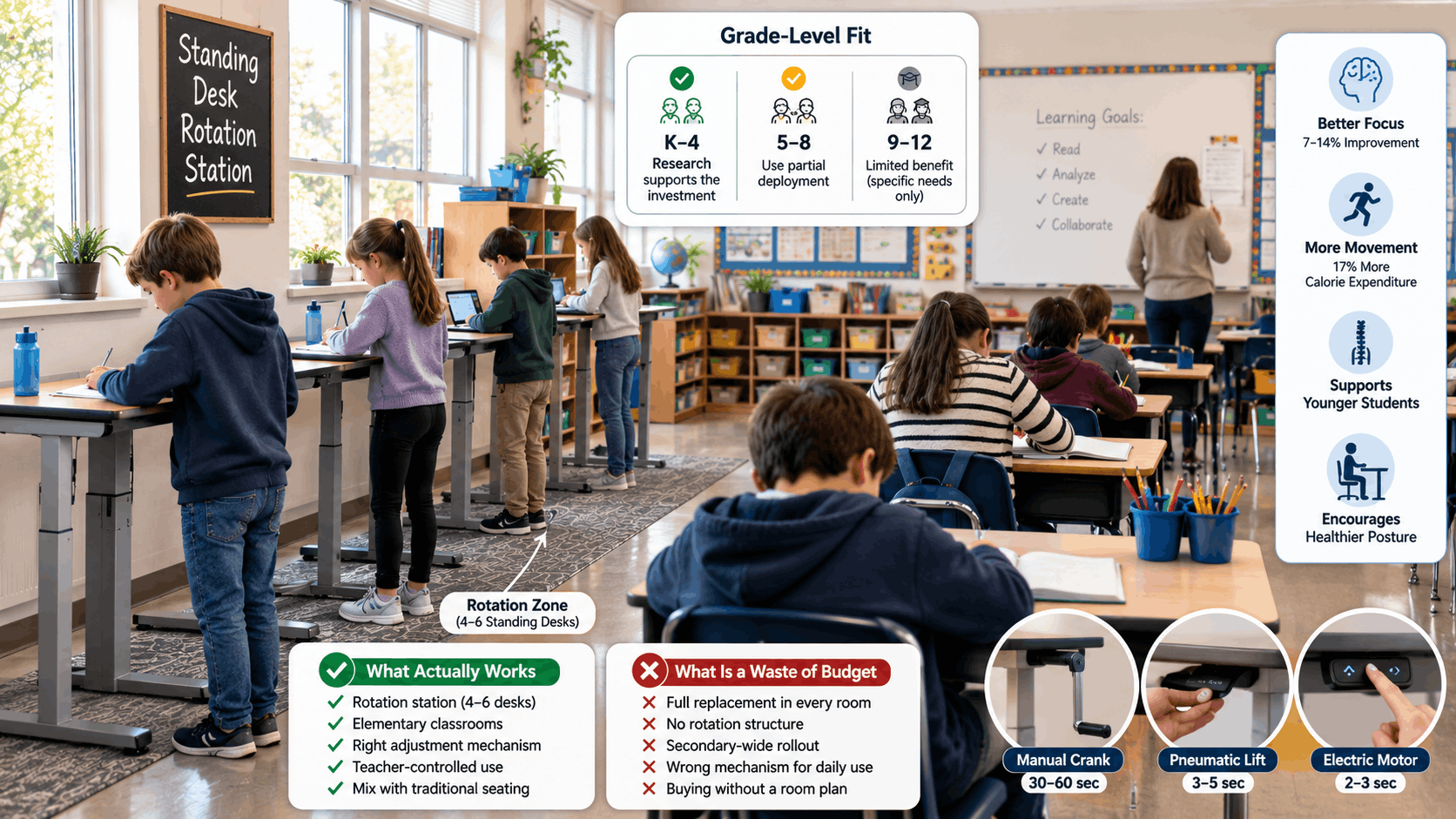
Studies on standing desks reported a 7 to 14 percent improvement in cognitive performance and task focus, alongside a 17 percent increase in calorie expenditure compared to traditional seated desks. Most of those studies were done in elementary classrooms with students in grades 2 through 4, and the greatest improvements showed up among younger students rather than older grades.
Younger students have less developed core stability. Sitting in a chair for six hours is physiologically harder at age seven than at age fifteen. The option to stand addresses a real physical need in early grades. By secondary school, that need becomes less pronounced, and the research reflects it.
Grade-level fit before ordering
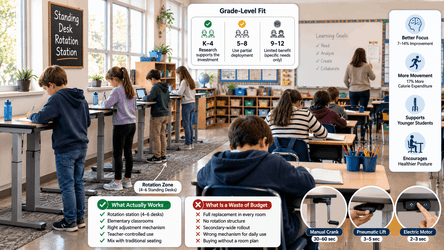
K through 4: research supports the investment, particularly for active classrooms. Grades 5 through 8: physical health benefit is real, but partial deployment fits better than full replacement. Grades 9 through 12: limited evidence for general cognitive benefit; best justified by specific accommodation needs.
Rotation station or full classroom replacement
Schools that report the strongest outcomes with standing desks usually start with a rotation zone instead of replacing every desk in the room. Four to six standing desks along one wall, active during specific work periods, gives every student access to a standing position without requiring each person to manage a mechanism throughout the day. The teacher decides when the zone is open. Students rotate through it. The rest of the room runs on standard seating and nothing about the main floor arrangement changes.
Full classroom replacement makes sense in two situations: new construction where the room is being configured from scratch, or an established active-learning room where the teacher already runs a model that involves frequent physical transitions. In an existing room with a traditional layout, replacing every desk with height-adjustable units creates a floor plan and a management problem that was not there before.
Many districts compare standing desks beside traditional classroom layouts before finalizing the room order, especially once circulation paths, storage, and floor space are factored into the plan. The full school classroom furniture catalog makes those side-by-side comparisons easier during planning.
The adjustment mechanism determines whether students actually use them
Three mechanisms. Each one fits a different use pattern.
Manual crank. Rotates a column to adjust height. Takes 30 to 60 seconds. No power required, nothing to break. Right for classrooms where students adjust once at the start of the class or period and leave it. Even done a few times a day, that only adds up to 5 to 7 minutes total. Wrong for rooms where students need to switch heights multiple times within a single period, because the time overhead adds up fast and in practice students stop adjusting to save the time.
Pneumatic lift. A lever releases a gas cylinder. Height adjustment takes a few seconds. Faster than a crank and still requires no power. The tradeoff is cycle count. Budget pneumatic desks in classrooms where students adjust multiple times daily can fail within two to three years as the cylinder loses pressure. Specify cycle-rated pneumatic mechanisms when daily adjustment is the expected use pattern.
Electric motor. Button-driven, two to three seconds, the most reliable for active use. Also the most expensive, and the cost multiplies across a full classroom deployment. For a single accommodation desk or a small active learning station, the premium is worth it. For 28 desks across a secondary classroom where students may adjust once a week, it is not.
| Mechanism | Adjustment Time | K-12 Reliability | Best Fit |
|---|---|---|---|
| Manual crank | 30 to 60 seconds | High, no moving parts | Once-daily setting, budget-conscious orders |
| Pneumatic lift | 3 to 5 seconds | Medium, cycle-rated spec required | Multiple daily adjustments, mid-range builds |
| Electric motor | 2 to 3 seconds | High with commercial motor spec | Accommodation desks, active learning stations |
Mechanism durability becomes a long-term replacement problem when adjustment systems are underspecified for how often students actually use them during the school day. The same issue shows up repeatedly in how to choose classroom desks for schools when districts focus on unit price instead of long-term classroom use.
ADA requirements when standing desks are in the room
Under ADA Standards section 902, work surface heights for children over age 5 must fall between 26 and 30 inches in accessible positions. For adult positions, the range is 28 to 34 inches with 27 inches of knee clearance underneath. At minimum, 5 percent of classroom desks must be wheelchair accessible.
A standing desk set to standing height is not an accessible position. A height-adjustable desk that lowers to the required range is. Fixed-height standing desks are not a compliant K-12 specification for this reason, and they remove the postural flexibility that makes the product useful in the first place.
Which positions in the room serve as accessible positions needs to be determined before the floor plan is finalized, not retrofitted after an accommodation request arrives. In a mixed classroom, confirming accessible positions in the layout before the order is placed avoids that problem. Our guide on why school furniture orders go wrong covers the specification and planning steps that catch these mismatches before anything ships.
Mixing standing and seated desks creates layout and ADA questions that are much easier to answer before anything ships. The Project Team maps positions, confirms clearances, and flags accessible spec requirements as part of the free room layout in two to three business days. Call 877-909-9910.
Start Your Free Room LayoutWhere the budget gets wasted
- Full secondary deployment without a driver. Secondary school full-classroom deployments funded by a general active-learning initiative, without a specific accommodation driver or a teacher requesting them, are the most consistent standing desk budget mistake in K-12. The desks get used as a novelty for the first few weeks. After that, students default to sitting, and the standing position stays locked at whatever height the last user set it to.
- Underspecified mechanism for the use pattern. A budget pneumatic desk in a classroom where students adjust multiple times per day fails within two to three years. The replacement cost erases the original savings.
- Height range that misses accessible positions. A standing desk with a minimum lowered height of 30 inches does not reach the accessible seated position for younger students or wheelchair users. The height range on the spec sheet is what matters, not the product category name.
- Floor space not planned for standing use. A student standing at a desk occupies more area than the desk footprint suggests. Body movement, stepping back, turning. A room at standard desk density cannot absorb a full standing desk deployment without layout adjustment, and that adjustment is not visible on a floor plan that only shows the static desk dimensions.
Procurement for standing desk orders
TIPS, NCPA, and PEPPM cooperative contracts allow districts to purchase furniture without running a separate competitive bid process, which usually shortens approval timelines and reduces purchasing paperwork. Today's Classroom is an authorized vendor on all three, and contract details by state are on the co-ops and contracts page. For mid-year additions or single-classroom replacements, Quick Ship items are available with five-business-day shipping.
When standing desks are added to a broader classroom furniture refresh, our guide on school furniture packages worth it covers when a bundled order saves money and when the overlap creates unnecessary cost.
Frequently asked questions
Are standing desks worth it for elementary school classrooms?
A Texas A&M study found 7 to 14 percent improvement in cognitive performance and 12 percent greater on-task engagement in elementary classrooms using stand-biased desks. Younger students have genuinely less capacity to sit still for long periods, and the physical option to shift position changes how those rooms run. For grades 5 and above, the evidence becomes more mixed and partial deployment fits better than full replacement.
What height range should the desk cover?
Under ADA section 902, the accessible seated height for children over age 5 is 26 to 30 inches. For most K-6 students, a comfortable standing working height runs roughly 38 to 44 inches depending on age and build. A desk adjusting between those two ranges covers both positions without needing separate units for each configuration. For secondary students, the seated ADA range extends to 34 inches and comfortable standing height is typically 42 to 48 inches. Confirm the full height range on the spec sheet before ordering.
What is the difference between a sit-stand desk and a standing-height desk?
A sit-stand desk adjusts between seated and standing heights. A fixed standing-height desk does not. For K-12 use, sit-stand is the only specification that makes sense. Fixed-height desks cannot meet ADA accessible position requirements and cannot accommodate the range of student heights across a classroom. Most standing desks sold for school use are height-adjustable, but confirming it on the spec sheet before ordering is faster than discovering otherwise after delivery.
Can ESSER funds be used for standing desk purchases?
Yes. Many districts used ESSER funding for classroom furniture, flexible seating, and active-learning room upgrades, although eligibility depended on how each district categorized the purchase and when the funding was allocated. Purchases through cooperative contracts also simplified documentation and approval workflows in many districts.
How many standing desks make sense for a partial deployment?
Most schools starting with partial deployment add four to six standing positions per classroom rather than replacing every desk in the room. Rooms built around regular student movement also run into storage and circulation problems once students start rotating between positions during the day. Our guide on how to choose classroom storage for schools covers the storage placement decisions that make active-learning rooms work operationally.
Related guides
- ●How to choose classroom desks for schools. Frame specifications, edge construction, and the cost calculation that affect long-term durability, adjustment reliability, and replacement cycles in K-12 classrooms.
- ●School furniture packages worth it. When bundled classroom orders reduce costs and where mixed room layouts create unnecessary overlap.
- ●Why school furniture orders go wrong. The pre-order decisions that determine whether a furniture purchase works for fifteen years or becomes a line item in next year's emergency budget.
- ●How to choose classroom storage for schools. What drives teacher adoption of classroom storage and what to confirm before ordering.
Today's Classroom carries standing desks, standard desks, storage, and classroom furniture across 200 brands and 10,000 products.
Ordering Standing Desks for Your District?
Send us your grade levels, room counts, and use pattern. We will map rotation zones, confirm accessible positions, and route the order through the right cooperative contract before anything ships.