School Furniture Packages: Worth It, or Overpaying?
Posted by Today's Classroom Team on 30th Jul 2026
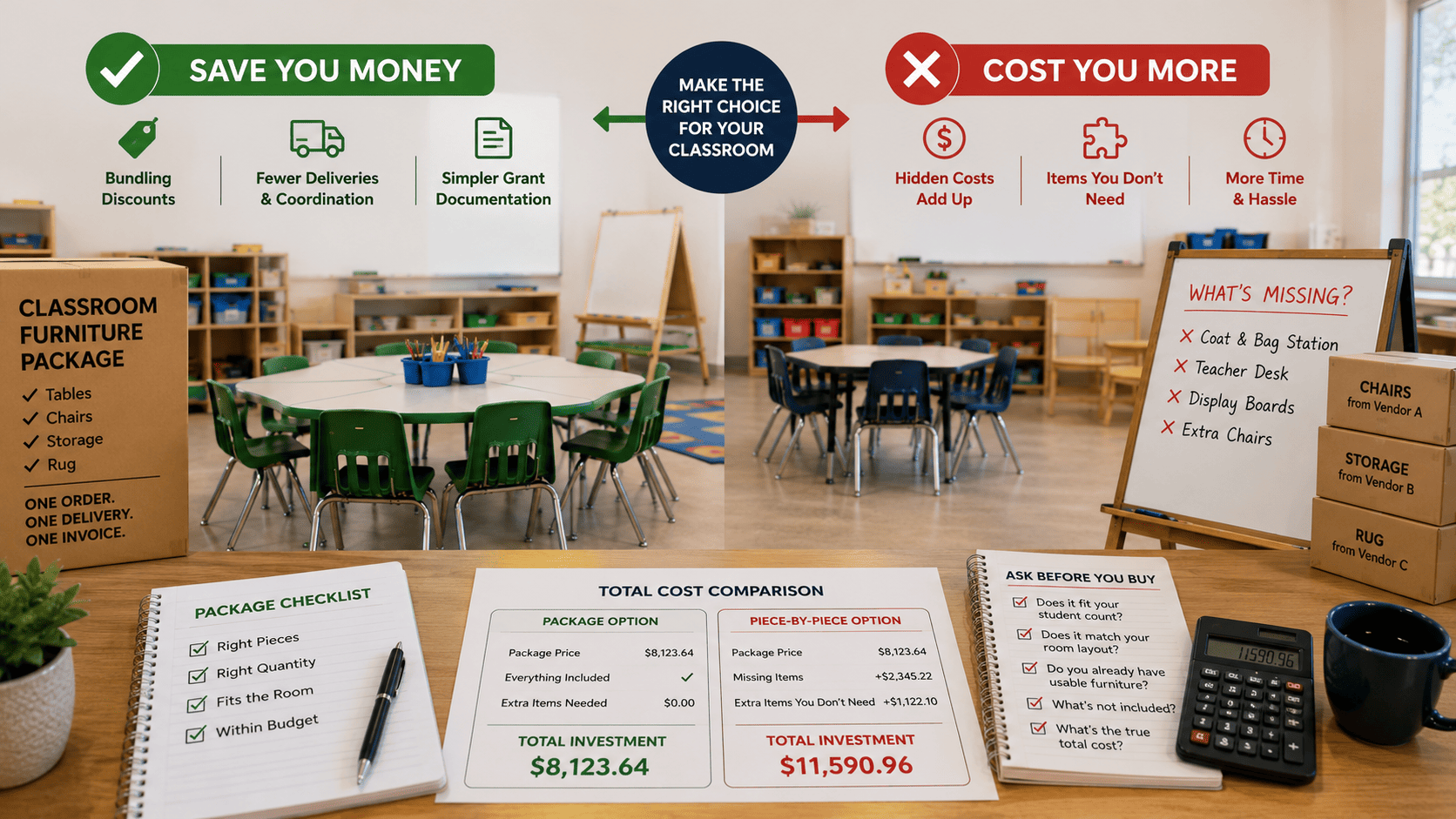
Here is what we see constantly. A principal gets a grant. The grant has a spending deadline. She goes looking for furniture, finds a package, sees that it covers tables, chairs, and storage in one order, and buys it. Six weeks later, the furniture arrives, and the package includes twelve chairs for a room that seats twenty-two students.
The decision behind it was not wrong, and the package received was not wrong. It was simply the wrong package for that room.
After 49 years of working with school districts, we have seen this go both ways. Packages that saved a district weeks of coordination and thousands of dollars. Orders where the package forced a school to buy items it already had and source everything it actually needed separately. The difference is almost always one thing: whether the package configuration matches what the room actually requires.
What a furniture package actually is and what it is not
A classroom furniture package is a pre-configured bundle where a manufacturer has grouped the pieces a specific room type typically needs. Tables, chairs, storage, sometimes a rug. One SKU, one price, one delivery, one invoice.
It is not a custom order. The configuration is fixed. You get what is in the bundle. The chair count, the table height, the storage type. Most packages have no flexibility; some have color options.
The fixed configuration is both the value and the risk. A room with a standard layout and a standard student count fits most packages cleanly. A room that has specific constraints, an unusual student count, existing furniture that cannot be matched, or a non-standard layout usually does not.
The decision comes down to one question before anything else. Does this room have a standard configuration or a specific one?
The first check
List everything the room needs. Then look at what the package includes. If those two lists match closely, the package is worth running the numbers on. If they diverge by more than two or three items, piece-by-piece ordering is likely the better path.
Where packages genuinely save money
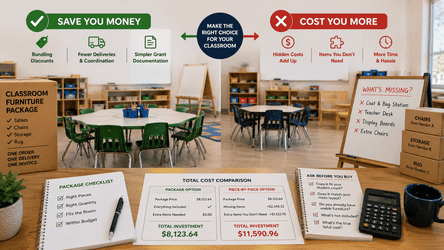
Three things drive the savings in a furniture package. Understanding all three tells you how to evaluate whether a specific package is actually a deal.
Manufacturer bundling discount
Manufacturers set package pricing below the sum of individual item prices to move complete configurations. That discount is real, not marketing. Where it applies most clearly is early childhood, because Jonti-Craft and similar manufacturers publish individual item pricing that can be added up and compared directly against the package price. The early childhood packages page shows current pricing across the full range.
Coordination savings
A piecemeal order for a full classroom involves sourcing tables from one place, chairs from another, storage from a third, potentially a rug from a fourth. Four separate purchase orders. Four deliveries arriving on different days. The business office processes separate invoices for each vendor. A package collapses all of that into one transaction. For a district running multiple room builds simultaneously, the administrative load difference is significant.
Grant documentation
This is where packages earn their clearest advantage. If the purchase is funded by an ESSER allocation or a state facilities grant, a single invoice for a complete room is dramatically simpler to document than fifteen line items from multiple vendors. Grant administrators verify expenditure against room function. One line item that reads: Jonti-Craft Preschool Classroom Package 3, room 104, $8,123.64 clears faster than a spreadsheet of individual items that together constitute a preschool classroom.
For districts managing multiple ESSER-funded rooms simultaneously, that documentation difference compounds across every room in the project.
The real cost calculation most schools skip
Before assuming a package saves money, run this check.
Take the package price. Then list every item in the package and its individual price. Then list what the package does not include that the room still needs.
That last list is where the math changes.
A package for a standard preschool room might include tables, chairs, a storage unit, and a rug. It does not include a coat and bag station. It does not include a teacher workstation. It does not include display boards. Those items are still needed. If they are sourced individually after the package is ordered, the true cost of furnishing the room is the package price plus the per-item cost of everything missing.
The other cost schools consistently undercount: replacement. A package at $8,000 with furniture that lasts twelve years has a different cost per year than a package at $6,500 with furniture that needs replacement in seven. The cheaper package is not cheaper over the life of the room.
When piece by piece wins
Piece by piece ordering is the right call in five specific situations.
- The room already has usable furniture. If a classroom has storage cabinets from a previous order that are in good condition, buying a package that includes storage is paying for something twice. Storage mistakes create some of the most expensive replacement decisions in K-12 rooms because schools often order around catalog dimensions instead of how teachers and students actually use the room every day. Our guide on how to choose classroom storage for schools covers the workflow and sizing problems districts usually discover after installation.
- The room serves multiple grade levels or ages. A package configured for kindergarten does not work for a room that runs kindergarten in the morning and a second-grade after-school program in the afternoon. The chair heights are wrong for one of the two. Build the order to the specific height range the room needs.
- The student count does not match the package configuration. Most packages are configured for 20, 24, or 30 students. A room of 17 students buying a 24-student package overpays for seven chairs and a table that does not fit the floor plan. Source to the actual count. Classroom desk specifications create the same issue at the product level. Frame gauge, desk height, edge construction, and configuration style affect replacement cycles far more than most districts expect during the first order. Our guide on how to choose classroom desks for schools breaks down the specs districts should verify before placing a classroom order.
- The room has a non-standard layout. An L-shaped classroom, a room with a support column interrupting the floor plan, or an unusually low ceiling height needs furniture positioned around those constraints. A package spec does not account for them.
- The order is a mid-year addition. A package is a complete room solution. If six desks and a storage unit need to be added to a room that is already partially furnished, a package forces purchase of items that are not needed. For mid-year additions, Quick Ship items ship within five business days. A package is not the right path.
What the actual numbers look like
These are Today's Classroom selling prices, not MSRP. The MSRP figures are included where the discount is large enough to affect the buy decision.
| Room Type | Package | TC Selling Price | MSRP |
|---|---|---|---|
| Preschool, standard | Jonti-Craft Preschool Package 3 | $8,123.64 | $11,724.73 |
| Preschool, alternate config | Jonti-Craft Preschool Package 2 | $8,582.88 | $12,584.68 |
| Kindergarten, standard | Jonti-Craft Kindergarten Package 2 | $8,883.13 | $12,969.76 |
| Kindergarten, comprehensive | Jonti-Craft Kindergarten Package 1 | $23,781.73 | $33,870.00 |
| Elementary, 24 students | CEF Elementary 24-student Package | $11,778.00 | N/A |
| PreK entry level | USA Capitol Flexible Pre-K | $4,461.75 | $7,759.57 |
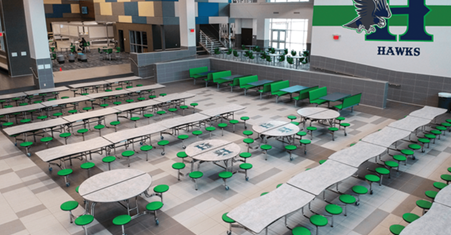
| Full cafeteria, standard | AmTab Mobile Bench Package | $79,076.94 | $204,581.00 |
| Full cafeteria, social seating | AmTab Mobile Social Package | $57,020.28 | $147,518.00 |
The early childhood numbers are the easiest to verify because Jonti-Craft's individual item pricing is publicly documented. The cafeteria packages are where the coordination argument is strongest. A full cafeteria build sourced individually involves significantly more vendor coordination than any classroom build.
Early childhood packages cover zone-specific configurations as well as full rooms. A school that needs only a literacy area or a sensory zone can source that without buying a full-room package.
Buying a package through a cooperative contract
Most districts above a certain spend threshold require competitive bidding. A cafeteria package at $79,000 triggers that requirement in almost every district. A classroom package at $11,000 often falls below it.
TIPS, NCPA, and PEPPM cooperative contracts allow purchase at pre-negotiated pricing without a separate bid. The competitive process was already completed at the contract level. Today's Classroom is an authorized vendor on all three. A school purchase order is all that is required. Full contract details by state are on the co-ops and contracts page.
ESSER-funded furniture purchases work through the same contract vehicles. A complete room package purchased through a cooperative contract with a single invoice is the cleanest possible ESSER expenditure documentation. One line item, one room, one invoice.
Have a package in front of you and not sure it fits your room? Send us the room's dimensions, student count, and use pattern. Our Project Team will tell you whether the package fits or which items to source individually. Free, no purchase required. Call 877-909-9910.
Get a Free Package ReviewFrequently asked questions
Is it possible to customize a package or does it come exactly as listed?
Most packages ship as a fixed configuration, but some manufacturers offer color options within the package, and a small number allow swaps at the SKU level for items like table height or chair size. The only reliable way to know for a specific package is to ask before ordering. Call 877-909-9910 and describe the room before assuming the package is not adjustable.
How do delivery timelines differ between packages and individual orders?
Packages ship as a unit when all items are ready. If one item in the package has a longer lead time than the others, the full package ships on the longer timeline. Individual orders allow each item to ship when ready. For a room that needs to be partially functional by a specific date, piece-by-piece ordering gives more timeline flexibility.
Can ESSER funds be used for furniture packages?
In most cases, yes. Furniture purchases tied to school reopening, in-person instruction, health and safety, or student learning environment improvements have qualified under ESSER guidance in most states. The U.S. Department of Education publishes current ESSER eligibility guidance. Confirm the specific requirements with your state coordinator before placing the order.
What happens if a package item arrives damaged?
Inspect everything at delivery before signing the delivery receipt. Damage noted on the receipt is the most straightforward path to a claim. For packages, if one item in the bundle is damaged, the claim covers that item specifically. The undamaged items are usable immediately. Do not hold the full package in storage waiting for a damage resolution.
How do I know if a package is the right fit before ordering?
The Project Team reviews the room dimensions, student count, and use pattern against the package configuration before the order goes out. If the package fits, the order proceeds. If it does not, the team identifies which items to source individually. That review takes two to three business days and costs nothing. Call 877-909-9910 or start at the Project Team page.
Related guides
- ●Why school furniture orders go wrong. The five decisions that determine whether a furniture order works for fifteen years or becomes a problem by November.
- ●How to choose classroom desks for schools. Frame gauge, edge construction, and the cost calculation that purchasing officers wish someone had shown them before the first order.
- ●How to choose classroom storage for schools. Why expensive cabinets get ignored by teachers and how to specify storage that actually gets used.
- ●Standing desks in schools: what works. Grade-level fit and adjustment mechanism specs for standing desks.
Browse school furniture for sale across 10,000 products and 200 brands at Today's Classroom.
Planning a Furniture Package Order?
Send us your rooms, student counts, and timeline. We will tell you which rooms fit a package cleanly and which are better sourced piece by piece.