The Classroom Storage Mistakes That Make Teachers Stop Using It
Posted by Today's Classroom Team on 3rd Aug 2026
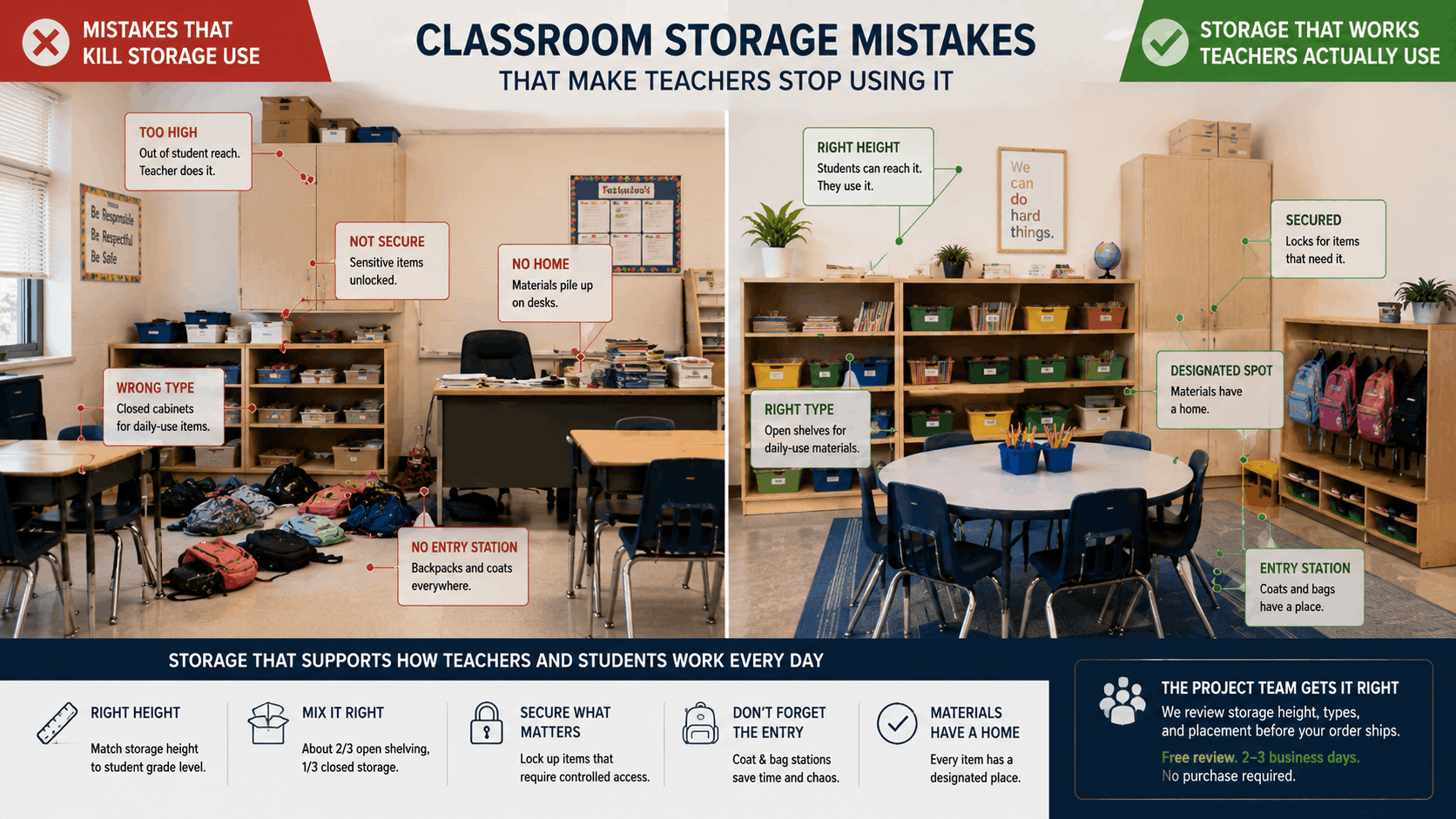
A classroom can have plenty of storage and still end up with supplies stacked on counters, materials piled near the teacher's desk, and backpacks scattered across the floor.
Most of the time, the problem is not the amount of storage in the room. It is where the storage was placed, how high it was built, or whether students can actually use it without stopping instruction.
The height problem nobody puts on the purchase order
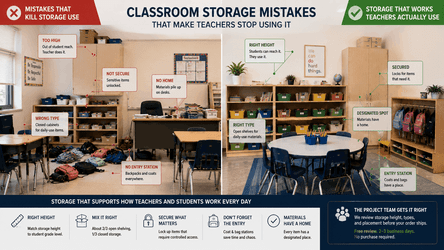
Height is the most common storage specification error in K-12 classrooms. It is also the easiest to get right and the least often confirmed before the order goes out.
The issue is straightforward. Student-accessible storage needs to be within reach of the students who are supposed to use it independently. A storage unit at 48 inches works for a sixth grader. The same unit in a preschool room means every supply run requires adult assistance. Students stop getting materials on their own, so the teacher ends up handling it instead. The storage is technically present and technically unusable for its intended purpose.
The reverse error is less obvious but equally common. Student-accessible storage in a high school classroom set at 24 inches means students are bending to retrieve materials multiple times per period. Over six hours, that is a daily ergonomic problem that shows up as avoidance. Students stop using the storage. Materials stay at the desks.
| Grade Level | Recommended Student Storage Height | Notes |
|---|---|---|
| PreK and Kindergarten | 24 to 30 inches maximum | Child-height access without climbing or straining |
| Grades 1 to 3 | 28 to 36 inches | Transition zone; confirm with room visit before ordering |
| Grades 4 to 6 | 36 to 42 inches | Standing reach for most elementary students |
| Grades 7 to 12 | 42 to 48 inches | Standard reach height for secondary students |
These are operational guidelines based on standard anthropometric ranges for children by grade level, not a manufacturer specification. Confirm with a room visit before finalizing any storage order. A teacher who is 5 feet 2 inches tall has different storage needs than one who is 5 feet 10 inches, and both are different from the students they serve.
The Project Team at Today's Classroom identifies storage height requirements alongside furniture positioning before anything ships. That is the single step that prevents height errors on large storage orders.
Open versus closed: the decision that drives daily teacher behavior
Open shelving and closed cabinets solve different problems. Ordering one where the other is needed creates a room that functions against the teacher's workflow rather than with it.
Open shelving makes materials visible and accessible. Students can retrieve and return items without assistance. In early childhood rooms, this is not optional. A three-year-old cannot open a cabinet door reliably. Open bins with picture labels are the only configuration that supports genuine student independence at that age. In elementary classrooms running station rotations, open shelving means students can access materials for their station without stopping instruction to ask. The operational argument for open shelving in K-6 rooms is strong.
Closed cabinets with locks solve a different problem. Assessment materials, cleaning supplies, medication, testing documents. Anything that requires controlled access in a school environment belongs in a locked cabinet. In licensed early childhood facilities, unsecured cleaning supplies are a safety violation. A cabinet with a lock is not a storage preference in those rooms. It is a compliance requirement.
The mistake that shows up constantly: a purchasing officer orders all open shelving because it is less expensive, or all locked cabinets because they look more professional. The room ends up with the wrong configuration for at least one of its storage functions, and teachers work around it from day one.
Good classroom storage keeps materials easy to reach without interrupting instruction. When the layout works, teachers and students stop wasting time moving around the room looking for supplies.
Today's Classroom Project Team
School storage cabinets come in open, closed, and combination configurations. The right mix for most K-6 rooms is roughly two-thirds open student-accessible shelving, and one-third closed teacher and secured storage. That ratio keeps student materials within reach while keeping controlled-access items secured.
Our guide on how to choose classroom desks for schools covers how desk and storage placement interact across the full room layout.
The coat and bag station: the item missing from almost every first order
A coat and bag station near the entry is not a storage category most purchasing officers think about. It does not appear on the standard room furniture checklist. It gets added as an afterthought, if at all.
The operational consequence: students arrive with backpacks, jackets, and lunch bags. Without a designated station within the first ten feet of the door, those items go on the floor under chairs. A classroom of 28 students generates 28 floor obstacles every morning. The custodial team cleans around them. Students trip over them during transitions. The teacher spends the first ten minutes of every day managing arrival rather than starting instruction.
A row of cubbies with hooks at child height eliminates that problem in one purchase. It is one of the highest return-per-dollar storage investments in an elementary classroom and one of the most consistently omitted items on first-time classroom furniture orders.
What to specify for a coat and bag station
Position within 10 feet of the entry door. Individual cubbies with a hook above and a shelf below for each student. Height matched to the grade level. For PreK and K, the hook should be no higher than 36 inches from the floor. For grades 1 through 6, 42 to 48 inches. For secondary hallway installations, standard locker height applies.
Why teachers stop using storage they did not choose
A teacher who had no input into the storage order and receives a configuration that does not match her workflow will route around it within two weeks. This is not stubbornness. It is efficient. The counter she has been using for three years is familiar. The new cabinet is not. Unless the cabinet is clearly better in a way she can see immediately, teachers go back to the setup they already know works.
Three specific configurations drive this pattern.
Storage positioned in the wrong location. A cabinet on the wall behind the teacher's desk requires her to turn away from students to access materials during instruction. A cabinet on the side wall within arm's reach of the teaching zone gets used constantly. Same product. Placement determines adoption.
Labels that only the teacher can read. Text-only labels on student storage in K-2 rooms exclude students who are still learning to read. Picture labels matched to the content, a drawing of crayons on the crayon bin, a drawing of scissors on the scissors bin, create student-operated storage that runs without adult involvement. Jonti-Craft's cubby systems include label holders specifically designed for this purpose.
Shelves that cannot be adjusted. A fixed-shelf cabinet ordered for a room where the storage needs change by semester is a cabinet that creates problems every time the room shifts. Adjustable shelves in 1.5-inch increments are a standard feature on Jonti-Craft storage cabinets. That flexibility costs nothing extra and prevents the situation where a shelf is four inches too low for the new curriculum materials every September.
One structural detail worth confirming before any storage order: warranty length. Jonti-Craft storage cabinets carry a lifetime warranty on the furniture construction. That is not a marketing claim. It is documented in the product warranty. A cabinet that carries a lifetime warranty is a cabinet the manufacturer is confident in enough to stand behind indefinitely. That confidence is worth weighing when the alternative is a budget cabinet with a 1-year warranty that arrives looking similar in the product photo.
The locking cabinet requirement most districts miss
In licensed early childhood facilities and in any K-12 room that stores controlled materials, locking storage is not a preference. It is a licensing and compliance requirement.
U.S. Consumer Product Safety Commission guidelines on child safety in educational environments, alongside most state licensing frameworks for early childhood programs, require that cleaning products, chemicals, medications, and any potentially hazardous materials be stored in locked enclosures inaccessible to children. A standard open cabinet with a magnetic catch does not meet this requirement.
Jonti-Craft storage cabinets include a lock and key on every closed-door model. The KYDZHinge system prevents finger pinching when doors are opened and closed by children. GreenGuard Gold certification on Whitney Brothers storage units confirms low chemical emissions, which matters in rooms where young children spend six or more hours per day in close contact with furniture surfaces.
These are specification details districts can verify before the order is placed instead of discovering problems later during inspections or daily classroom use. Our guide on why school furniture orders go wrong covers the planning, delivery, and specification mistakes that create long-term problems for schools.
Buying classroom storage through a cooperative contract
A single classroom storage order usually stays below the competitive bid threshold for most districts. Large storage refresh projects across multiple classrooms usually do not.
TIPS, NCPA, and PEPPM cooperative contracts allow districts to purchase classroom furniture at pre-negotiated pricing without running a separate bid process. Today's Classroom is an authorized vendor on all three, and the co-ops and contracts page lists contract details by state.
For mid-year classroom additions or replacement orders, Quick Ship items are available with five-business-day shipping.
Ordering storage for a full room or a district refresh? Send us the room dimensions, grade levels, and student counts. Our Project Team will map storage placement by function and confirm heights before anything ships. Free, two to three business days. Call 877-909-9910.
Get a Free Storage Layout ReviewFrequently asked questions
What is the difference between a cubby and a storage cabinet for classroom use?
A cubby is open-fronted, designed for student access to personal items and frequently used materials. A storage cabinet has doors, typically with a lock, and is designed for materials that need controlled access or periodic retrieval rather than daily use. Most well-configured classrooms need both. Cubbies handle student-operated daily materials. Cabinets handle teacher-managed or controlled-access items. Ordering all cubbies or all cabinets typically means at least one storage function is not being met.
Do Jonti-Craft storage cabinets come with a warranty?
Yes. Many Jonti-Craft storage cabinets include a lifetime warranty on the furniture construction. That matters in K-12 classrooms where the same cabinet may stay in use for 15 to 20 years across changing room layouts and grade assignments. You can browse school classroom furniture and compare warranty details by product category.
Is locking storage required in elementary classrooms?
Yes, for hazardous items like cleaning products, chemicals, and medications, CPSC guidelines and most state licensing rules require locked, child-inaccessible storage. Regular classroom supplies do not need it. Check your state's specific rules before finalizing a room.
How do I know what storage configuration to order without visiting the room?
The Project Team at Today's Classroom produces a scaled room layout showing storage positioned by function, student age group, and traffic flow before the order is placed. That layout is available within two to three business days at no cost. It is the most reliable way to confirm storage configuration without a site visit, and it catches height, placement, and configuration errors before anything ships.
Can ESSER funds be used for classroom storage purchases?
ESSER funding eligibility depends on the district, funding category, and purchase timeline. Many districts used ESSER allocations for classroom furniture, storage, and room modernization projects through cooperative purchasing contracts. The co-ops and contracts page lists current contract details by state.
Related guides
- ●Why school furniture orders go wrong. The five decisions that determine whether a furniture order works for fifteen years or creates problems from the first week.
- ●School furniture packages worth it. When a pre-configured room bundle saves money versus ordering piece by piece, and when it costs more.
- ●Why cheap classroom desks cost more than the ones you did not buy. Frame gauge, edge construction, and the cost calculation that changes the entire desk-buying decision.
- ●Standing desks in schools: what works. Grade-level fit and adjustment mechanism specs for standing desks.
Browse school classroom furniture across 10,000 products and 200 brands at Today's Classroom.
Ordering Storage for Your Classroom or District?
Send us the rooms, grade levels, and use pattern. We will map storage by function, confirm heights, and route the order through the right cooperative contract before anything ships.