Why Cheap Classroom Desks Cost More in the Long Run
Posted by Today's Classroom Team on 3rd Aug 2026
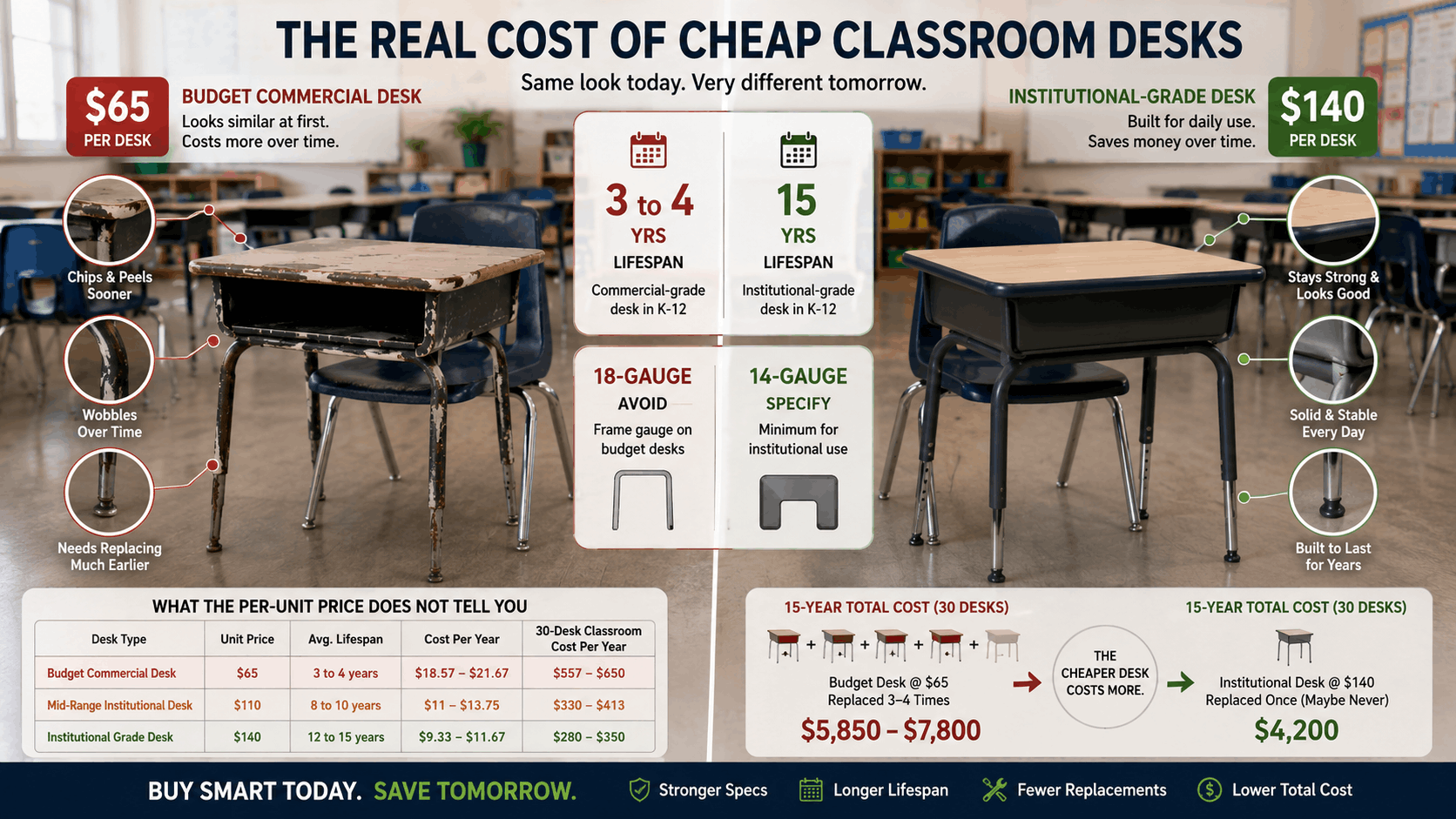
A desk that costs $65 and a desk that costs $140 can look almost identical in a catalog photo. Three or four years later in a classroom, the difference becomes obvious.
One still feels solid after daily cleaning, constant movement, and years of student use. The other starts wobbling, chipping at the edges, and needing replaced much earlier than expected.
Most of that comes down to specs districts never see unless they ask for them directly.
What the per-unit price does not tell you
Most purchasing officers look at the per-unit price and stop there. The per-unit price does not account for how many times that desk gets replaced.
| Desk Type | Unit Price | Avg. Lifespan | Cost Per Year | 30-Desk Classroom Cost Per Year |
|---|---|---|---|---|
| Budget commercial desk | $65 | 3 to 4 years | $18.57 to $21.67 | $557 to $650 |
| Mid-range institutional desk | $110 | 8 to 10 years | $11 to $13.75 | $330 to $413 |
| Institutional grade desk | $140 | 12 to 15 years | $9.33 to $11.67 | $280 to $350 |
Over a 15-year period, a classroom of 30 budget desks at $65 each gets replaced three to four times. Total spend: $5,850 to $7,800, plus the labor and coordination cost of three replacement orders.
A classroom of 30 institutional desks at $140 each gets replaced once, maybe never within that window. Total spend: $4,200.
The cheaper desk costs more. Not eventually. Over any realistic budget horizon.
That same cost problem shows up at the room level when districts buy furniture packages that include items the classroom does not actually need. Our guide on school furniture packages worth it breaks down where bundled classroom packages genuinely reduce costs and where piece-by-piece ordering makes more sense.
Why frame gauge matters
If there is one spec worth checking before any desk order, it is the frame gauge. In the US gauge system, the lower the number, the thicker the steel. 14-gauge is thicker than 18-gauge.
| Frame Gauge | Thickness | What It Means in a Classroom |
|---|---|---|
| 18-gauge | ~1.2 mm | Budget construction. Shows flex and wobble within two years of daily student use. |
| 16-gauge | ~1.5 mm | Acceptable for light commercial use. Not rated for K-12 daily use long term. |
| 14-gauge | ~1.9 mm | Institutional minimum. Handles daily student contact without structural fatigue. |
| 12-gauge | ~2.7 mm | Premium institutional. Used in high-traffic classrooms and heavier-use environments. |
What budget listings never show you
Most product listings on budget desk sites do not publish the frame gauge. That absence is intentional. If the gauge were 14 or better, it would be front and center as a selling point. When you cannot find the gauge, assume it is 18 or lighter and plan accordingly.
Surface and edge construction: where the visible failure happens
The frame is what fails structurally. The surface and edge are what fail visually, and they often go first.
The laminate surface
School desk surfaces take marker, paint, acetone from hand sanitizer, food acids, cleaning chemicals, and the occasional craft knife from a student who should not have had one. A laminate surface rated for light commercial use peels, stains, and gouges within two to three years under those conditions.
High-pressure laminate (HPL) rated for institutional use holds up under those same conditions for the full lifespan of the desk. The spec to look for on a product sheet is HPL or phenolic-backed laminate. If the surface is described only as laminate without a rating, it is not institutional grade.
Edge banding vs. bonded edge
This is the detail most buyers never check until a desk comes back looking like it was attacked with a letter opener.
Edge banding is a strip of material glued to the raw edge of the desk substrate. In a school environment, that glue joint fails. Students pick at it. Cleaning solutions dissolve it. Once the band lifts, the substrate underneath is exposed, and the desk starts absorbing moisture and looking damaged within weeks.
T-mold edge construction integrates the edge material into the surface rather than adhering it. There is no joint to fail. It does not peel. On a desk that will be wiped down with disinfectant 180 times a year for fifteen years, that matters enormously.
Quick spec check before any desk order: Ask for (1) frame gauge, (2) surface specification by type and rating, (3) edge construction method. If any of the three are missing from the product spec sheet, the desk is not institutional grade.
The Project Team reviews desk specs against room configurations before the order goes out. Free, two to three business days. No purchase required. Call 877-909-9910.
Start Your Free Desk Spec ReviewThe configuration decisions that affect how the room actually functions
Set up the desk correctly for durability, then make these three configuration calls before the order goes out.
1. Desk style: four-leg vs. T-leg vs. tablet arm
Four-leg desks are the most stable configuration for standard classroom use. Four contact points on the floor, no cantilever stress, easiest to maintain. Right for most K-12 classrooms.
T-leg desks use two larger leg assemblies instead of four individual legs. They are easier to stack and store and work well in rooms that need to be cleared regularly. The tradeoff is slightly less lateral stability on uneven floors.
Tablet arm desks attach a writing surface to one side of the chair frame. They work for lecture-style rooms where students are not doing collaborative work. They do not work for rooms running group activities because they cannot be reconfigured into clusters.
2. Height: fixed vs. adjustable
Fixed-height desks are cheaper and more durable. Adjustable-height desks cost more and add mechanical components that require maintenance.
For classrooms serving a single grade level, fixed height is usually the right call. Specify the height range for the grade. For rooms that serve multiple grades or need to flex across age groups, height-adjustable desks reduce replacement orders when the room's grade assignment changes. Different school desk configurations handle those room changes very differently, especially once storage, circulation paths, and group layouts enter the equation.
3. ADA accessible positions
ADA Standards require at least one accessible desk position per classroom. The minimum clearance is 27 inches of knee height, 30 inches of width, and 19 inches of depth under the desk surface. Most standard desks in the 28 to 30-inch table-height range meet this clearance. Confirm it on the spec sheet before ordering, not after the room is furnished and an accommodation request arrives.
Storage creates similar workflow problems when cabinet height, shelf access, and room layout get specified around catalog dimensions instead of how students and teachers actually use the room every day. Our guide on how to choose classroom storage for schools breaks down the sizing and placement mistakes districts usually discover after installation.
Five desk types that consistently underperform in K-12 settings
These show up in school orders constantly. None of them are right for the environment they end up in.
- Office desks marketed for schools. Office furniture is rated for 8 hours of use per day by one adult. A classroom desk gets used by 5 to 6 different students across a school day, each bringing a different weight, movement pattern, and level of care. Office ratings do not cover that use profile.
- Folding tables used as permanent desks. Folding tables are for temporary setups. The hinge mechanisms are not rated for daily fixed use. Legs that should fold stay folded, joints loosen, and surfaces that should be horizontal start to slope within a year.
- MDF-core desks at any price point. MDF absorbs moisture. In a school environment where cleaning is regular, and spills are inevitable, an MDF core will swell, warp, and delaminate. Specify particleboard with moisture-resistant treatment or solid-core construction.
- Desks with plastic leg caps on hard floors. Plastic leg caps on VCT or hardwood floors scratch the surface with every movement. Specify felt or rubber floor glides. This is a detail so small it almost never makes the purchase order and costs the district a floor resurfacing job within five years.
- Single-source budget bundles. Desks sold in bulk sets at a low per-unit price are often the same budget construction sold individually, just discounted for volume. The discount does not change the frame gauge. Run the cost-per-year math regardless of the per-unit price.
Buying classroom desks through a cooperative contract
Institutional-grade classroom desks sit comfortably below the competitive bid threshold for most districts when ordered one classroom at a time. A 30-desk order at $140 per unit is $4,200. That is below the bid threshold in nearly every district.
TIPS, NCPA, and PEPPM cooperative contracts cover classroom furniture purchases without a separate bid. Today's Classroom is an authorized vendor on all three. The co-ops and contracts page has contract details by state.
Procurement problems usually start earlier in the process, long before the purchase order gets approved. Our guide on why school furniture orders go wrong covers the planning, delivery, and room-layout mistakes districts run into most often.
For mid-year replacements or smaller classroom additions, Quick Ship items are available with five-business-day shipping.
Frequently asked questions
What frame gauge should I specify for elementary school desks?
14-gauge steel is the institutional minimum for K-12 use. For elementary classrooms, 14-gauge handles the daily use pattern without issue over a 12 to 15-year lifespan. For middle and high school, where students are larger and furniture takes more physical contact, 12-gauge is worth the cost difference.
Is there a warranty I should ask for on classroom desks?
Yes. Institutional-grade desk manufacturers typically offer 10-year frame warranties on products built to that standard. A desk with a 1-year or 3-year warranty is not built to institutional standards regardless of what the product description says. The warranty length is a reliable proxy for the construction quality when you cannot get the spec sheet.
Can ESSER funds be used to replace classroom desks?
Yes, if the desks meet the ESSER expenditure criteria for improving the learning environment, health and safety, or in-person instruction. Most classroom desk replacements qualify under those criteria in most states. TIPS, NCPA, or PEPPM cooperative contracts generate a single invoice per order, which simplifies grant documentation. Confirm state-specific requirements with your ESSER coordinator before placing the order.
How do I know if a desk is actually institutional grade from the product listing?
Four things to check on any listing before buying. Frame gauge published and at 14 or lower. Surface specified as HPL or equivalent institutional laminate. Edge construction described as bonded, T-mold, or integrated rather than banded. Warranty of 10 years or longer on the frame. If any of these are missing, call the vendor and ask specifically. If they cannot answer, the desk is not institutional grade.
What is the right desk height for middle school students?
For grades 6 to 8, the standard desk height range is 28 to 30 inches with a seat height of 17 to 19 inches. The physical test is the same at any age: seated with feet flat on the floor, elbows rest at desk height without raising the shoulders. For rooms covering a wide age range, height-adjustable desks set to the correct range for the grade being served avoid the ergonomic problems that show up as fidgeting and posture complaints by the second semester.
Related guides
- ●Why school furniture orders go wrong. The five pre-order decisions that determine whether a furniture purchase works for fifteen years or becomes a line item in next year's emergency budget.
- ●School furniture packages worth it. When a pre-configured room bundle saves money versus ordering piece by piece, and when it costs more than building the order yourself.
- ●How to choose classroom storage for schools. Why expensive cabinets get ignored by teachers and how to specify storage that actually disappears into the room's workflow.
- ●Standing desks in schools: what works. Grade-level fit and adjustment mechanism specs for standing desks.
Browse school classroom furniture across 10,000 products and 200 brands at Today's Classroom.
Ordering Classroom Desks for Your District?
Send us your grade levels, room counts, and use pattern. We will spec desks to a 12 to 15-year lifespan and route the order through the right cooperative contract before anything ships.