How to Set Up an Elementary School Classroom: Furniture Guide
Posted by Today's Classroom Team on 4th Aug 2026
Last August, a district purchasing officer in Minnesota placed an order she had placed a dozen times before. Thirty individual desks for a third-grade classroom. Same spec, same configuration, same logic as fifteen years ago.
By October, the principal was on the phone asking about returns. The desks were fine for independent work. For small group reading, math rotations, and partner projects, they were in the way. The teacher had spent two months rearranging her day around furniture that was not built for how third grade actually runs.
The replacement order came on top of the original, for a room that could have been right the first time.
This is the most common and most avoidable mistake in elementary school furnishing. This guide covers what works in K-5 classrooms, why it works, and what to confirm before the purchase order goes out.
In this article
- Why elementary classrooms need a different approach
- What layout actually works in a K-5 classroom
- How to get the sizing right before you order
- How storage should work in an elementary classroom
- What display space a K-5 classroom actually needs
- What it actually costs to furnish an elementary classroom
- Frequently asked questions
Why elementary classrooms need a different approach than the rest of the building
Walk into a third-grade classroom on a Tuesday afternoon, and you might see students in a circle on the rug for read-aloud. An hour later, the same room has six small groups rotating through math stations. After lunch, it is independent reading with students spread across the room.
Three different configurations. One afternoon. Same space.
A high school classroom runs one configuration most of the day. Students face forward, the teacher leads from the front, the furniture barely moves. Elementary classrooms are different. The furniture has to work as hard as the teacher does, shifting to support whatever the lesson requires.
When it cannot do that, the cost is real. A student sitting in a chair that is two inches too tall loses focus within 20 minutes because their body is uncomfortable. A teacher who needs two adults to rearrange tables stops rearranging. A storage system designed for adult height means every supply run interrupts instruction.
The furniture decisions you make for a K-5 room shape how students move through the day, how independently they operate, and how quickly the teacher can shift gears. That is why it deserves more thought than a line item on a purchase order. The room-by-room school furnishing guide covers how elementary classrooms fit alongside the other spaces in a K-12 building.
What layout actually works in a K-5 classroom?
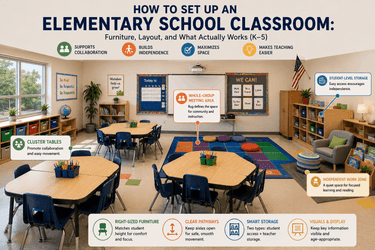
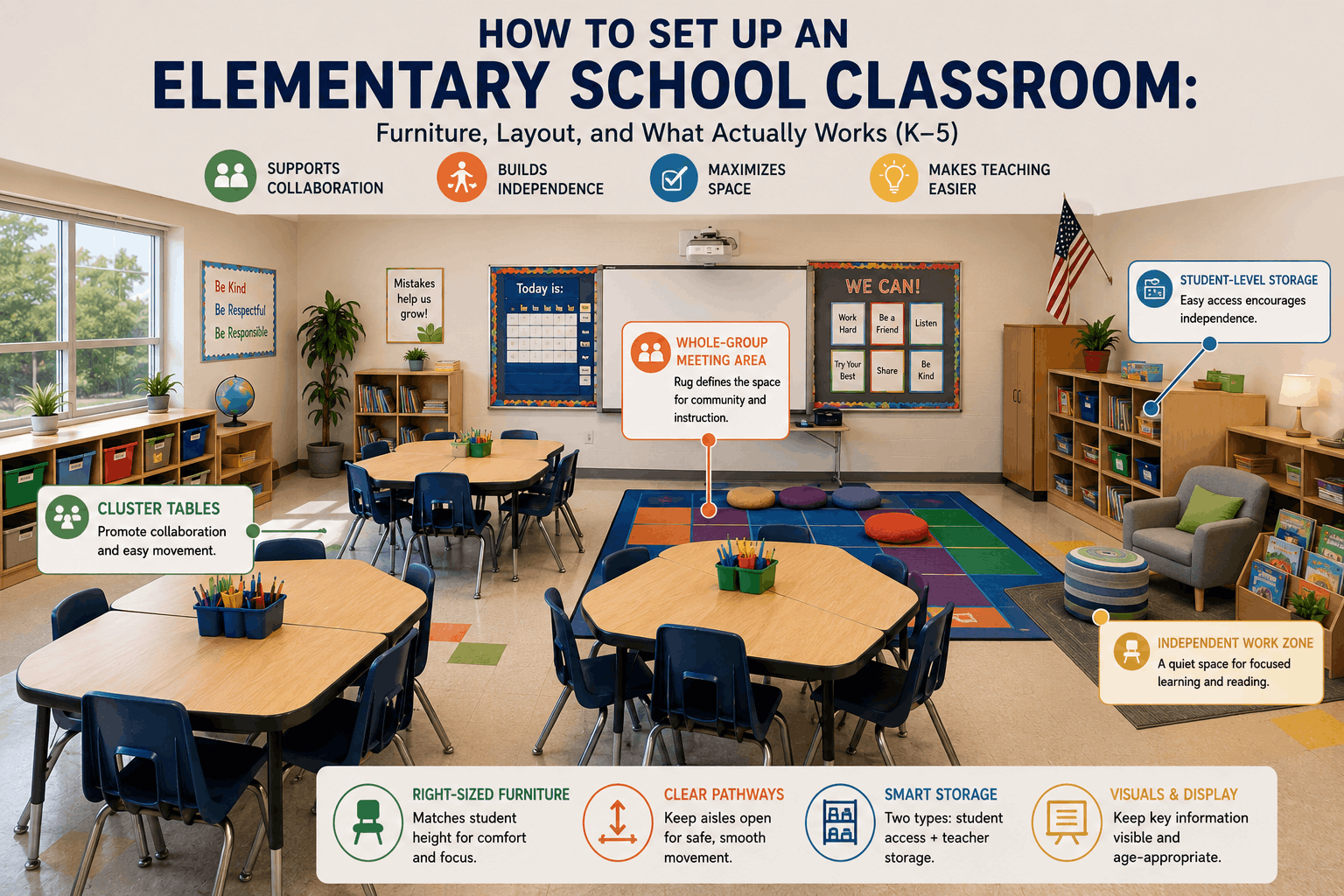
The layout that works in most elementary classrooms combines collaborative table clusters, a defined whole-group meeting area anchored by a rug, and an independent work zone at the perimeter.
Why table clusters beat rows for K-5
Rows of desks were designed for a teaching model where information flows in one direction: teacher at the front, students in seats. That model covers maybe a third of what happens in an elementary classroom today.
The rest of the day requires students to talk to partners, rotate through stations, work on projects, and transition multiple times. Rows create a logistical obstacle for all of that. Every transition becomes a furniture-moving event.
Classroom tables and chairs arranged in clusters of four to six keep students facing each other, which supports collaboration without requiring the room to change shape. The teacher can reach every student in a cluster without crossing the room. When direct instruction starts, students redirect their attention forward without anyone moving a chair.
This is also where Smith System tables deliver. Their activity tables are built specifically for K-5 collaborative setups, with rounded edges, durable surfaces, and casters that make daily reconfiguration a one-person job.
The whole-group meeting area
Every elementary classroom needs a defined floor space for morning meeting, read-aloud, and whole-group lessons. This is where the rug comes in. The rug is not a decoration. It tells students where to go and marks a zone that signals a shift from work time to community time.
Size it correctly, or every morning meeting becomes a crowd management problem.
- ●6x9 feet seats 12 to 16 students
- ●8x10 feet seats 18 to 24 students
- ●9x12 feet seats 24 to 30 students
Undersized by one seat, and students on the edges are off the rug, which becomes its own negotiation every day. Oversized, and the rug eats up floor space the room needs for movement and station rotations.
The independent work zone
Not every student works best at a cluster table all day. A counter-height surface along one wall, or a reading corner with a small chair and low bookshelf, gives students who need separation a designated spot. When there is a named place, students go there without asking. That small thing removes a daily negotiation from the teacher's plate.
How to get the sizing right before you order
Sizing is where district-level orders go wrong most often. A purchasing officer ordering school classroom furniture for an entire building defaults to one chair size and one table height across all grade levels. It saves time on the order and creates discomfort in every room where the sizing does not fit the students.
Here is the correct sizing range by grade:
| Grade | Table Height | Seat Height |
|---|---|---|
| Kindergarten | 20 to 22 inches | 12 to 14 inches |
| Grades 1 to 2 | 22 to 24 inches | 13 to 15 inches |
| Grades 3 to 4 | 24 to 26 inches | 15 to 17 inches |
| Grade 5 | 26 to 28 inches | 16 to 18 inches |
The test is simple. A seated student should rest their elbows on the table without raising their shoulders. If their shoulders are up, the table is too high. If they are hunching forward, the table is too low. Neither position is comfortable for six hours, and by the afternoon, it shows up as fidgeting and fatigue.
Activity tables for schools are worth the additional upfront cost. They serve K-5 without replacement as grade assignments change from year to year. Our guide on why cheap classroom desks cost more covers the frame, edge, and surface specifications that determine whether classroom furniture lasts three years or fifteen.
One mistake that shows up in new builds: ordering chairs to match the grade 3 to 4 table height, then placing them in kindergarten rooms where the table is six inches lower. The chair is right for one room and wrong for the other. Always size the chair to the student first, then verify the table height matches.
How storage should work in an elementary classroom
A classroom where students have to ask for every pencil is a classroom where instruction stops. The real goal of elementary storage is student independence, not organization for its own sake.
Two-tier storage solves this.
Student-level storage at 24 to 36 inches maximum height. Books, supply bins, manipulatives, personal materials. Students reach it themselves and return items themselves without interrupting the lesson. Open shelving and labeled cubbies work well here. For kindergarten and grade 1, picture labels on bins work better than text labels because students are still learning to read.
Teacher-level and secured storage above 36 inches. School storage cabinets with locking doors at standard cabinet height handle materials that need adult oversight, items locked during testing periods, and curriculum resources that rotate by unit.
A ratio that works in most K-5 rooms: roughly 60 percent student-level, 40 percent teacher-level. Flip it, and the room requires more adult intervention than it needs to. Our guide on how to choose classroom storage for schools covers the height, placement, and configuration decisions that determine whether teachers actually use the storage after it arrives.
One item that gets left off nearly every first elementary order: a coat and bag station near the door. Students arrive with backpacks, jackets, lunch boxes, and sometimes gym bags. Without a dedicated spot within 10 feet of the entrance, those items end up on the floor under desks. That is a tripping hazard and a source of morning chaos that a row of cubbies with hooks would have prevented. It is not a nice-to-have. It is traffic management.
What display space does a K-5 classroom actually need?
Elementary classrooms have more on the walls than any other room in the building. Word walls, anchor charts, student work, calendar math, behavior systems, unit vocabulary. Most classrooms run out of wall space before the end of October.
More wall space is not the answer. Better use of what is there is.
Three zones, three functions.
Front wall: the instructional surface. A dry-erase board at the front is non-negotiable in every K-5 room. Direct instruction happens here. Size it to the wall width, not to a standard catalog size.
Side walls: rotating content. Open display boards for schools handle what changes weekly: student work, current anchor charts, unit vocabulary. Specify self-healing cork. Standard cork crumbles under the pin volume of an active elementary room within a school year. A self-healing cork closes the hole every time it is pinned. On a board that gets pinned 30 times a week, that difference shows up by November.
Hallways and shared spaces: secured displays. Hallway content needs to stay in place without anyone watching it. Enclosed bulletin boards with security flush locks on the hardware keep posted materials secured. This is the right specification for any display left unattended.
One display decision that creates long-term problems: mounting everything at adult height. A word wall at 6 feet is invisible to a kindergartener. Elementary display content belongs in the lower two-thirds of the wall, where students can actually read it.
What does it actually cost to furnish an elementary classroom?
Most buyers ask this first. Most guides avoid answering it directly.
A fully furnished K-5 classroom for 24 to 30 students runs between $8,000 and $16,000 for a standard setup. Here is where the money goes:
| Item | Typical Cost Range |
|---|---|
| Tables and chairs for 24 to 30 students | $3,500 to $6,000 |
| Classroom rug for whole-group area | $300 to $800 |
| Student and teacher storage | $1,500 to $3,500 |
| Whiteboard and display boards | $500 to $1,200 |
| Teacher workstation and chair | $400 to $800 |
| Entry storage, book bins, cubbies | $500 to $1,500 |
The range comes down to two variables: brand tier and configuration. A room built with Smith System tables and chairs sits at the higher end of each line. A room built with standard commercial furniture sits lower and typically needs replacement in five to eight years. Furniture built for schools lasts fifteen to twenty.
That math matters when you are writing a grant application or presenting a capital budget request. The higher upfront cost on school-grade furniture almost always wins over a 15-year horizon compared to replacing commercial furniture twice.
Classroom furniture packages bundle tables, seating, and storage into pre-configured room setups. CEF's Elementary 24-student package covers tables, seating, and teacher storage in a single order. That eliminates sizing mismatches and simplifies the purchase order significantly. When a bundled package genuinely saves money versus ordering piece by piece is covered in our guide on school furniture packages worth it.
See the co-ops and contracts page for purchasing through TIPS, NCPA, and PEPPM cooperative contracts without a separate bid process. For the pre-order specification and planning steps that catch problems before the purchase order goes out, see why school furniture orders go wrong.
Spending grant money on classroom furniture? The last thing you want is an order that does not fit the room. TC's Project Team maps your exact dimensions, positions every piece to ADA clearance standards, and delivers a 3D rendering before anything ships. Free, no purchase required, no sales pressure. Call 877-909-9910.
Get Your Free Classroom LayoutFrequently asked questions
How many tables does an elementary classroom need for 28 students?
Seven tables seating four students each, or six tables seating four to five, cover 24 to 28 students with room for circulation. This leaves enough floor space for a whole-group rug area and a perimeter work zone. Individual desks for the same count require more floor space and less flexibility for the configuration changes that happen throughout an elementary day.
What seat height is right for second graders?
For grades 1 to 2, a seat height of 13 to 15 inches allows most students to sit with feet flat on the floor and elbows resting at table height without raising their shoulders. The table height that pairs with this range is 22 to 24 inches. For mixed-age rooms or furniture that needs to last across multiple grade cycles, height-adjustable chairs and tables in this range remove the guesswork every time class assignments change.
Does elementary classroom furniture need to meet ADA requirements?
Yes, for any table or workspace a student in a wheelchair may need to use. ADA minimums require 27-inch knee clearance height, 30-inch width, and 19-inch depth. Most activity tables in the K-5 height range meet this when specified correctly for the grade. Confirm it on the product spec sheet before ordering. Today's Classroom Project Team flags ADA positioning in every room layout as part of the free planning service.
How long does a classroom rug last in an elementary school?
With the right backing, a classroom rug typically lasts 5 to 7 years. The wrong backing on hard floors causes lifting at the corners within months, so use KIDply backing for hard floors and ActionBac for carpet subfloor. The rug also needs Class I NFPA certification to pass a fire inspection in a licensed school building, and CRI Green Label Plus certification for indoor air quality. Rugs for classrooms from Carpets for Kids, Flagship, and Joy Carpets meet these requirements and come in sizes matched to standard K-5 class counts.
Can elementary classroom furniture be purchased through a school contract without a separate bid process?
Yes. Today's Classroom holds active contracts with TIPS, NCPA, and PEPPM cooperative purchasing programs. District buyers can order elementary classroom furniture through existing cooperative contracts without issuing a separate competitive bid. The bid has already been completed at the contract level. Schools using ESSER funds can also purchase through these contracts. See the co-ops and contracts page for full details or call 877-909-9910.
Related reading
- ●How to furnish a school: a room-by-room guide for K-12 buyers. The parent guide covering every major space in a K-12 school, including standard classrooms, PreK rooms, cafeterias, science labs, art rooms, and technology spaces.
- ●Why school furniture orders go wrong. The five pre-order decisions that determine whether a furniture project works for fifteen years.
- ●School furniture packages worth it. When a bundled classroom order saves money versus ordering piece by piece.
- ●Why cheap classroom desks cost more. Frame gauge, edge construction, and cost-per-year math that changes the desk buying decision.
- ●How to choose classroom storage for schools. Storage placement and configuration decisions that determine teacher adoption.
- ●Standing desks in schools: what works. Grade-level fit, adjustment mechanism, and where the standing desk budget gets wasted.
- ●How to furnish a PreK and early childhood room. Cluster follow-on covering early childhood configurations, rug certifications, and student-scale storage.
- ●How to furnish a school cafeteria. Cluster follow-on covering unitized bench tables, non-marring casters, and ADA aisle widths.
- ●Science lab furniture for K-12 schools. Cluster follow-on covering surface specs by course content, SEFA 8 compliance, and bench configurations.
Browse school classroom furniture across 200-plus brands and 10,000-plus products at Today's Classroom.
Setting Up an Elementary Classroom or Grade Level?
Send us your room dimensions, grade level, and student count. We map furniture placement to ADA clearance, confirm sizing to grade, and route the order through the right cooperative contract before anything ships.