How to Furnish a School Cafeteria: Tables, Layout, and Costs
Posted by Today's Classroom Team on 4th Aug 2026
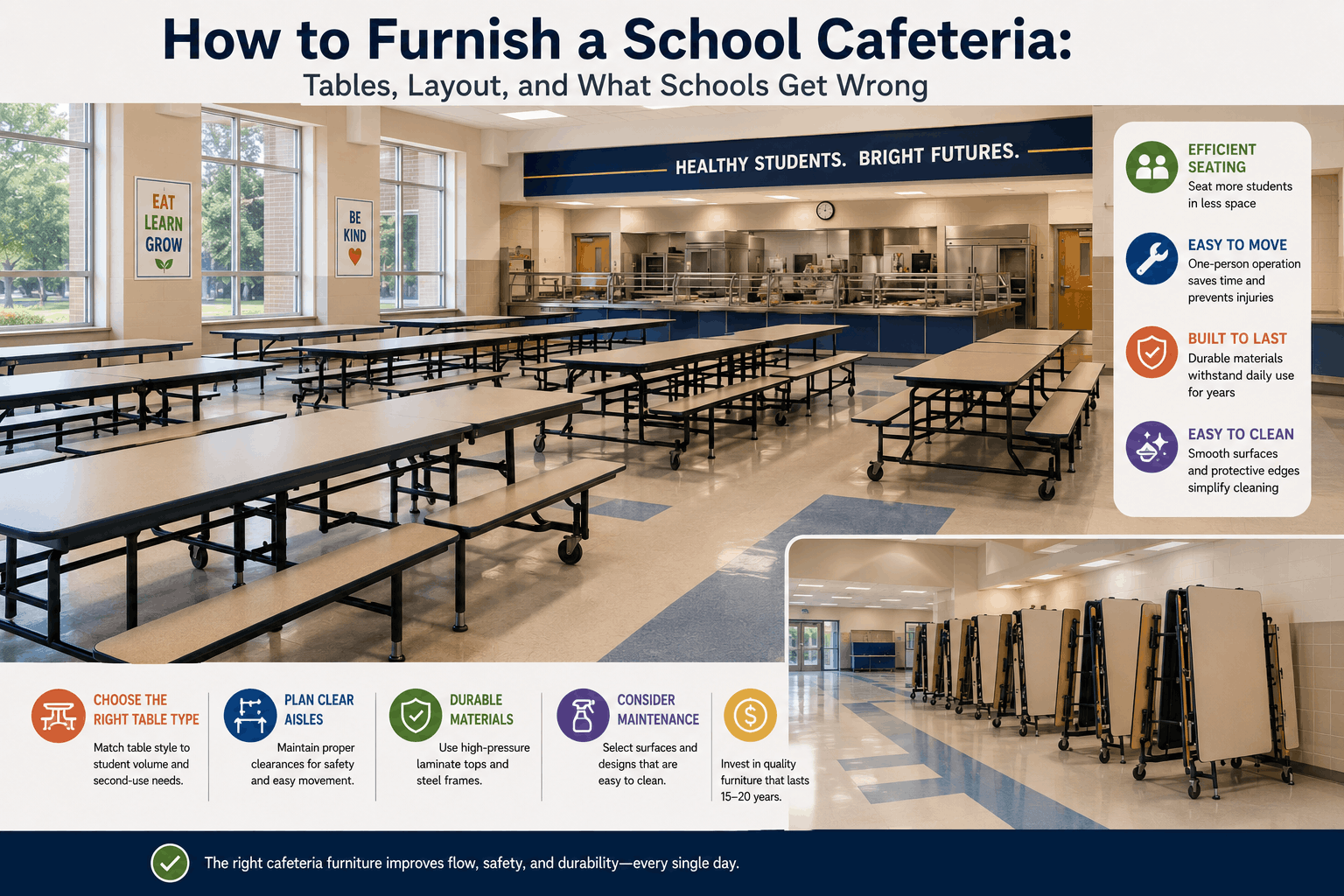
Figuring out how to furnish a school cafeteria the right way is harder than it looks. A facilities director in Illinois found that out the hard way.
She ordered cafeteria tables in June. The tables arrived in August. They looked right, fit the room, and came in under budget. By November, her custodial team had filed three injury reports. The tables were heavy, awkward to fold, and required two people to move each one.
"We had three injury reports by November," she said. "That is when we knew the tables were wrong."
The cafeteria doubled as an assembly space and needed to be cleared twice a week. The tables had torsion bars rated for occasional use. What the school needed was equipment rated for daily repositioning by a single custodian. The replacement order came on top of the original, for a room that could have been right the first time.
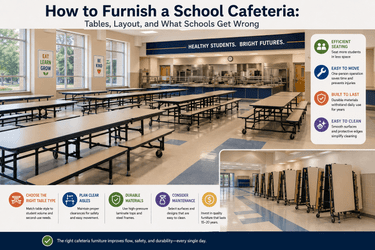
This guide covers which table type fits which situation, what specs prevent the most common problems, how to lay out a cafeteria so it passes inspection and functions under real conditions, and what a full build actually costs. For how the cafeteria fits alongside the other rooms in a K-12 build, see the room-by-room school furnishing guide.
In this article
- Why cafeteria furniture is its own category
- Which table type is right for your cafeteria
- Layout, clearance, and what fails inspection
- The specs that separate good cafeteria tables from problem ones
- What a cafeteria build actually costs
- Frequently asked questions
Why cafeteria furniture is its own category
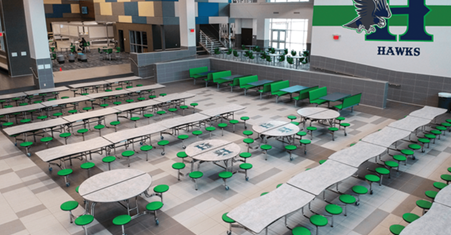
A school cafeteria is the most operationally demanding room in the building. It serves 200 to 600 students in 20-minute rotations. It gets cleaned and reset multiple times a day. In most schools, it doubles as an assembly space, a gymnasium overflow, a testing room, or a community event venue. The furniture has to support all of that, day after day, for 15 to 20 years.
Standard commercial furniture does not hold up in this environment. Restaurant tables are not designed to be folded and moved daily. Office furniture is not built for the impact load of several hundred students sitting down at once. Cafeteria furniture built for K-12 use is a specific product category with specific construction standards. Buying outside that category is the single most common cafeteria furnishing mistake.
Three things make cafeteria furniture different from everything else in the building.
It has to move. Most school cafeterias flip to a second use at least twice a week. Tables need to fold flat, roll on casters without floor damage, and store against a wall without blocking a fire exit. Tables that require two people to move will not get moved consistently. Tables that scratch the floor will damage a surface that costs thousands to repair.
It has to survive cleaning. Cafeteria tables get wiped down with commercial disinfectants multiple times a day, every school day. Table edges laminated with standard edge banding eventually peel, leaving seams where food and bacteria collect. Once that happens, no amount of wiping fixes the problem.
It has to seat students efficiently. A cafeteria serving 300 students in 25 minutes requires a layout where students find seats quickly, move through serving lines without blocking seating areas, and exit without creating a bottleneck at the door. The table configuration determines whether that works.
Which table type is right for your cafeteria?
The table type decision is the most consequential choice in a cafeteria build. It determines how the room operates every single day. Here are the six configurations and when each is the right call.
Unitized bench tables: the standard for high-volume K-12
Browse cafeteria bench tables to see available configurations before you commit to a table type.
It works because it is fast. AmTab's mobile bench tables are designed specifically for single-operator daily repositioning. A standard cafeteria room of 20 tables can be cleared in under 15 minutes using the torsion bar lift mechanism. When a school needs the cafeteria cleared for a 1:00 PM assembly and lunch ends at 12:40 PM, that 15-minute window is the difference between a smooth operation and a facilities crisis.
The AmTab Mobile Bench Cafeteria Package, which includes a mix of elliptical bench tables, round bench tables, and mobile folding booths, comes in at $79,076.94 at Today's Classroom's price versus a $204,581.00 MSRP.
Round tables with separate chairs: for flexible or smaller spaces
Round pedestal tables with individual chairs work in secondary dining areas, faculty lounges, or common spaces where the cafeteria does not need to flip to a second use regularly. They create a more relaxed environment for upper-grade dining areas.
They do not work for high-volume K-12 cafeterias. Round tables seat fewer students per square foot than bench tables. Individual chairs require collection and stacking before the floor can be cleared. Under time pressure, that adds significant work for custodial staff.
Social seating: booths, stool tables, and cafe-height surfaces
Mixing booth tables with standard cafeteria tables creates a modern dining environment that students actually want to be in. FurnitureLab's Cafeteria Package A (mixed booth and standard seating) starts at $69,190.00, and Package B at $75,788.50, at Today's Classroom pricing.
This mixed-seating approach works best in schools that have space to combine seating types rather than filling the entire floor with one format.
Stool tables: for modern, flexible cafeterias
Stool tables for schools at counter height or standard height create flexible social clusters that work for eating and for informal gathering outside meal periods. AmTab's Mobile Social Cafeteria Package, with a mix of high collaboration tables and round stool tables, comes in at $57,020.28 and is the lowest entry point of the full cafeteria packages. This format works best in secondary schools where the cafeteria functions as a student commons area throughout the day.
Wall-mounted tables: for space-constrained cafeterias
Wall-mounted cafeteria tables fold flat against the wall when not in use and eliminate the need for a storage alcove. Both against-the-wall and set-in-wall configurations are available.
The tradeoff is installation cost and the fact that wall-mounted tables cannot be repositioned once installed. Right for a small secondary dining area with a fixed layout. Not the right call for a multipurpose cafeteria that needs daily flexibility.
Wheelchair accessible tables: beyond minimum compliance
Wheelchair accessible cafeteria tables are built specifically for full wheelchair access, rather than tables that incidentally meet the clearance height.
The difference matters in cafeterias serving students who use power wheelchairs, which require more maneuvering clearance than manual chairs. Specifying a dedicated accessible table rather than relying on a standard table's minimum clearance removes the ambiguity from your ADA compliance documentation.
Layout, clearance, and what fails inspection
A cafeteria layout that looks right on paper and fails in practice is a predictable problem with a straightforward fix: calculate the clearances before the furniture order goes out, not after it arrives.
Three clearance standards determine whether a cafeteria layout passes inspection and functions safely.
ADA accessible aisles. The ADA Standards for Accessible Design require a minimum 36-inch aisle width for accessible paths of travel. Primary circulation routes, meaning the paths students use to move from the serving line to their seats and from their seats to the exit, should be 44 to 48 inches in practice. That width prevents the bottlenecks that create both safety problems and behavior problems during peak lunch periods.
ADA table clearance. At least one accessible seating position per table must meet ADA minimums: 27-inch knee clearance height, 30-inch width, and 19-inch depth. For unitized bench tables, confirm the accessible position count before ordering. Bench configurations that attach seating on all sides can reduce the accessible position count below what the room requires.
USDA space guidelines. The USDA recommends 10 to 12 square feet per student in a school dining area. For a cafeteria seating 300 students, that is 3,000 to 3,600 square feet of net dining space, not including the serving line, traffic lanes, and storage alcoves.
Three steps before the purchase order goes out:
- Map the room to scale with all fixed elements marked: serving line, exits, support columns, floor drains, electrical panels.
- Calculate aisle widths from each exit point and confirm primary circulation routes meet the 44 to 48-inch practical minimum.
- Confirm net dining square footage against the USDA guideline for your maximum occupancy count.
For the pre-order specification and planning steps that catch clearance and layout problems before the purchase order goes out, see our guide on why school furniture orders go wrong.
Cafeteria layout getting complex? TC's Project Team maps cafeteria floor plans to scale, confirms ADA aisle widths, and flags egress spacing before a single piece ships. Free, no purchase required. Call 877-909-9910.
Start Your Free Cafeteria LayoutThe specs that separate good cafeteria tables from problem ones
Every cafeteria table product listing looks similar. The specs that determine whether a table holds up for 15 to 20 years versus five to eight are not always visible in the product name or the photo. Here is what to look for before placing a large order.
Torsion bar mechanism
The torsion bar is the spring-loaded component that makes a unitized bench table fold and unfold with controlled resistance. A table without a properly rated torsion bar requires significant manual force to fold and is harder to control during movement. A correctly rated torsion bar folds smoothly with one hand and stays locked until deliberately released. AmTab's tables use torsion bars rated for daily single-operator use. Ask for the load rating, not just confirmation that a torsion bar is present.
Automatic storage lock
A cafeteria table that unfolds accidentally while being moved through a hallway is a liability. AmTab and FurnitureLab both include automatic storage locks that keep tables locked in the folded position until deliberately released. This is the spec that prevents a folded table from opening onto a student in a crowded corridor. Confirm it is present and that it requires a deliberate action to release.
Non-marring casters
Standard casters scratch VCT, hardwood, rubber, and polished concrete flooring. Non-marring casters protect the floor surface for 15 to 20 years of daily movement. Specify this explicitly on the order. It is not always the default, and replacing a damaged cafeteria floor costs significantly more than the caster upgrade.
Edge construction
Standard edge banding on cafeteria tables is laminate applied with adhesive. Under daily exposure to food acids, moisture, and commercial disinfectants, that adhesive eventually fails. Once the edge starts peeling, the seam collects food residue and bacteria that cannot be cleaned out.
Tables with bonded edge construction, where the edge material is permanently bonded to the table top with no adhesive joint, have no seam to fail. A cleaning crew can wipe the entire surface, edge to edge, with one pass. That is the difference between a five-year replacement cycle and a fifteen to twenty-year one. Ask specifically whether the edge construction is adhesive-applied laminate or permanently bonded. The answer changes the table's real lifespan. Our guide on why cheap classroom desks cost more covers the same edge and frame spec problems in the context of classroom desks.
Frame gauge
Institutional cafeteria tables use heavier steel framing than standard commercial tables. A lighter frame will flex under the impact load of daily student use and begin showing structural fatigue within a few years. Ask for the gauge specification on the frame, not just the product name. This information is in the product spec sheet, not the listing description.
Spec checklist before you order
Torsion bar load rating confirmed for single-operator daily use. Automatic storage lock present and requires deliberate release. Non-marring casters specified. Edge construction is permanently bonded, not adhesive laminate. Frame gauge confirmed on spec sheet.
What a cafeteria build actually costs
Cafeteria furniture operates at a different budget scale than classroom furniture. Here are the actual TC prices on complete cafeteria packages currently available.
| Package | Configuration | TC Price |
|---|---|---|
| AmTab Mobile Social Cafeteria Package | Stool tables and high collaboration tables | $57,020.28 |
| AmTab Mobile Stool Cafeteria Package | Stool table mix | $67,295.36 |
| FurnitureLab Cafeteria Package A | Booth and rectangle table mix | $69,190.00 |
| FurnitureLab Cafeteria Package B | Booth and rectangle table mix | $75,788.50 |
| AmTab Mobile Bench Cafeteria Package | Bench tables, round tables, mobile booths | $79,076.94 |
| AmTab Complete Cafeteria Package | Full cafeteria build, all table types | $139,786.25 |
All prices are Today's Classroom's current selling price. MSRP on these packages runs 50 to 100 percent higher. The AmTab Complete Cafeteria Package, for example, carries an MSRP of $236,671.00 at a selling price of $139,786.25.
For most K-12 cafeteria builds, the $57,000 to $79,000 range covers a standard cafeteria of 200 to 400 students with the right mix of table types. The $139,000 package covers a comprehensive build with every table configuration included.
A cafeteria build at this budget level typically triggers a district competitive bid requirement. That process adds weeks or months to the timeline and does not always result in better pricing than what cooperative contracts already provide. Schools purchasing through TIPS, NCPA, or PEPPM co-op contracts can buy at these prices immediately without a separate bid, because the bid has already been completed at the contract level. On a $70,000 purchase, that is not a small benefit. Full details are on the co-ops and contracts page. For when a bundled package saves money versus ordering piece by piece, see our guide on school furniture packages worth it.
View all packages at the cafeteria packages page, or browse individual school lunch tables by configuration type.
Replacing your cafeteria before the next school year? A $70,000 order that fails an ADA inspection or needs a layout revision after delivery is a facilities nightmare. Our Project Team maps your exact room dimensions, calculates every clearance, and confirms the right package before anything ships. Free, no obligation. Call 877-909-9910.
Get Your Free Cafeteria LayoutFrequently asked questions
What is the difference between a unitized bench table and a separate-seating table?
A unitized bench table has the seating attached to the table frame in a single unit. It folds flat, rolls on casters, and can be moved and stored by one person. A separate-seating table uses individual chairs or stools that must be collected and stacked before the floor can be cleared. For high-volume K-12 cafeterias that flip to a second use regularly, unitized bench tables are the right choice. Separate seating works in commons areas and secondary dining spaces where the room does not need to be cleared under time pressure.
How long should cafeteria tables last?
Institutional cafeteria tables from AmTab and FurnitureLab, built with proper torsion bars, automatic storage locks, non-marring casters, and bonded edge construction, last 15 to 20 years under daily K-12 use. Standard commercial tables in the same environment typically last five to eight years. The construction differences that account for that gap are in the spec sheet: frame gauge, edge construction method, caster rating, and torsion bar load rating. None of these are visible in a product photo.
What ADA clearances does a cafeteria layout need to meet?
ADA requires a minimum 36-inch aisle width for accessible paths of travel and 27-inch knee clearance height, 30-inch width, and 19-inch depth at accessible seating positions. In practice, primary circulation routes should be 44 to 48 inches wide to prevent peak-hour bottlenecks. Wheelchair accessible cafeteria tables in the Today's Classroom catalog are built specifically for full wheelchair access rather than incidental clearance compliance. TC's Project Team calculates every clearance as part of the free planning service before the order goes out.
Can a cafeteria package be purchased using a cooperative contract?
Yes. Today's Classroom is an authorized vendor on TIPS, NCPA, and PEPPM cooperative purchasing contracts. A district can purchase any of the cafeteria packages listed above through one of these contracts without running a separate competitive bid, because the bid has already been completed at the contract level. On a $70,000 to $140,000 purchase, that eliminates weeks or months from the procurement timeline. The co-ops and contracts page has the details on which contract works for your district and state.
How much space does a school cafeteria need per student?
The USDA recommends 10 to 12 square feet of net dining space per student. For a cafeteria serving 300 students, that is 3,000 to 3,600 square feet of dining area, not counting the serving line, traffic lanes, or storage space. A cafeteria that is undersized for its occupancy creates the crowding, noise, and behavior problems that better furniture alone cannot fix. If the room is undersized, the right answer is a layout that prioritizes traffic flow and exit clearance alongside a conversation about serving schedule adjustments.
What is the difference between bonded edge construction and standard edge banding?
Standard edge banding is laminate applied to the table edge with adhesive. Over time, exposure to food, moisture, and disinfectants breaks down the adhesive bond. The edge starts to peel, and the gap between the laminate and the table top collects food residue that cannot be cleaned out. Bonded edge construction permanently bonds the edge material to the table top with no adhesive joint. There is no seam to fail, no gap to collect residue, and no peeling. A table with bonded edge construction can be wiped clean in one pass. That spec is the difference between replacing tables every five years and keeping them for fifteen to twenty.
How many cafeteria tables does a school need for 300 students?
For 300 students eating at the same time, plan seating for all students with about 10 to 12 square feet per student. That equals roughly 3,000 to 3,600 square feet of dining space. An 8-foot unitized bench table seats 16 to 20 students. Using 16 seats per table, you will need about 19 tables for 300 students. Add a 10 to 15 percent buffer to handle peak periods and maintain accessible seating without dropping below capacity. Our Project Team can calculate exact table counts from your floor plan at no charge before you order.
Related reading
- ●How to furnish a school: a room-by-room guide for K-12 buyers. The parent guide covering every major space in a K-12 school, from standard classrooms through science labs and cafeterias.
- ●How to set up an elementary school classroom. The K-5 sibling guide covering table clusters, sizing, storage, and layout for elementary classrooms.
- ●How to furnish a preschool classroom. The early childhood sibling guide covering age-scale sizing, licensing certifications, and the five-zone classroom layout.
- ●Science lab furniture for K-12 schools. The science lab sibling guide covering chemical-resistant surface specs, SEFA 8 compliance, and bench configurations for K-12 labs.
- ●Why school furniture orders go wrong. The five pre-order decisions that determine whether a furniture project works for fifteen years.
- ●School furniture packages worth it. When a bundled package saves money versus ordering piece by piece.
- ●Why cheap classroom desks cost more. Frame gauge, edge construction, and cost-per-year math that applies to cafeteria tables too.
- ●How to choose classroom storage for schools. Storage placement and configuration decisions that determine teacher adoption.
- ●Standing desks in schools: what works. Grade-level fit and adjustment mechanism specs for standing desks.
Browse school furniture for sale across 200-plus brands and 10,000-plus products at Today's Classroom.
Furnishing or Replacing a School Cafeteria?
Send us your room dimensions, student count, and use pattern. We map the layout, confirm ADA aisle widths, and route the order through the right cooperative contract before anything ships.