How to Furnish a Preschool Classroom: Setup, Furniture and What Works
Posted by Today's Classroom Team on 4th Aug 2026
The director of a Head Start program in Georgia had a licensing inspection scheduled for September. She had ordered a rug online in July. It looked good in the photos, was the right size, and arrived on time.
It failed the inspection.
The rug did not carry a Class I NFPA fire rating. In a licensed early childhood facility, that is not a technicality. It is a code requirement. She had to pull the rug, reorder a compliant one, and delay her opening by three weeks while waiting for delivery.
Nobody told her to check the fire rating before she ordered. She did not know to ask.
That is the difference between buying preschool classroom furniture from a general retailer and buying from a supplier who has spent 49 years furnishing licensed school buildings. This guide covers what a preschool classroom actually needs, what certifications matter for licensing, and how to furnish a complete room without piecing it together from five different catalogs.
In this article
- How a preschool classroom differs from every other room you will furnish
- How to size furniture for young children
- Rugs, certifications, and what fails a licensing inspection
- The five zones every preschool classroom needs
- Storage that works for young students
- What it actually costs to furnish a preschool classroom
- Frequently asked questions
How a preschool classroom differs from every other room you will furnish
A kindergarten teacher once described her classroom as the only room in the building where the furniture has to babysit. She was not entirely wrong.
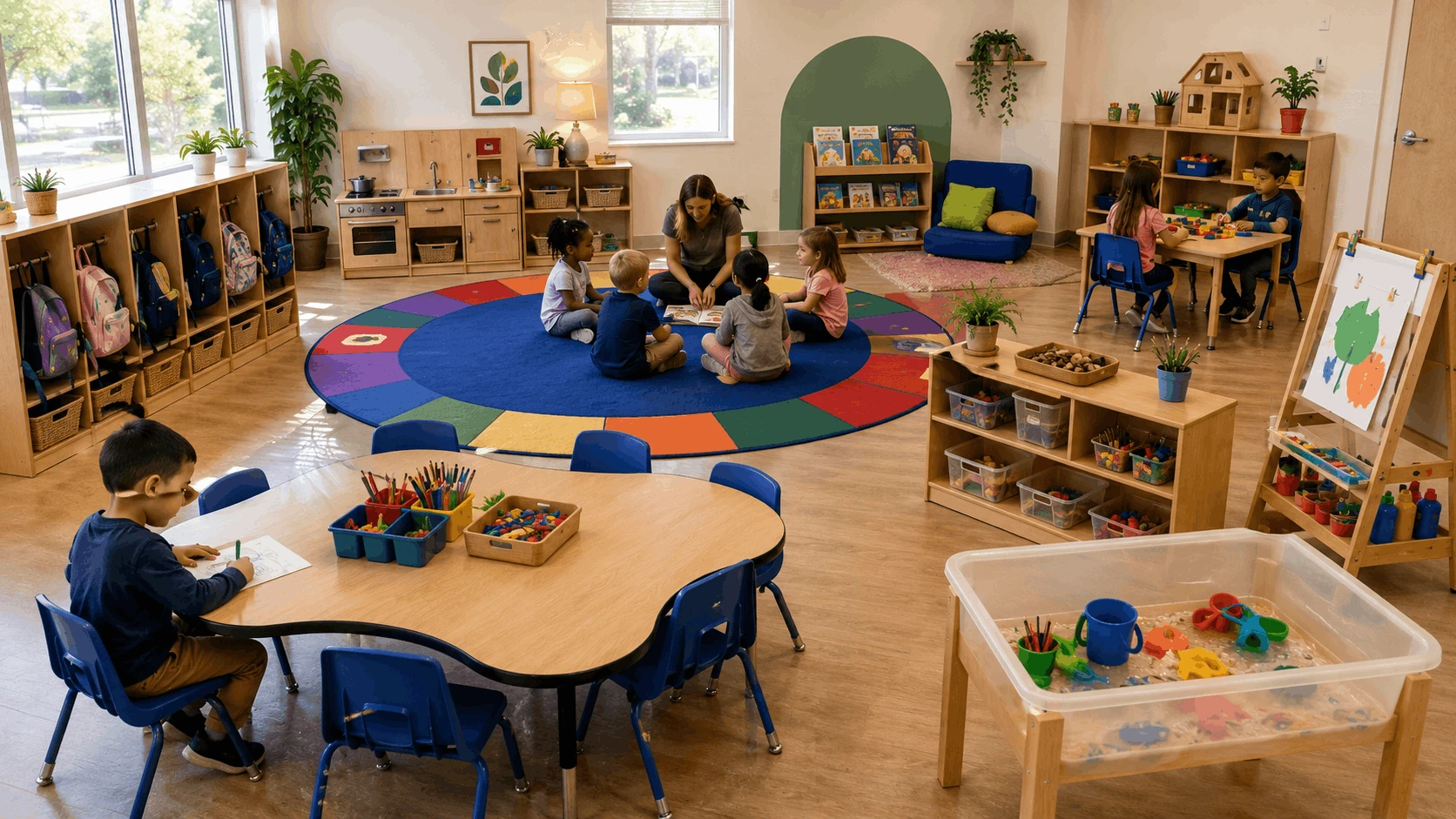
In a preschool or early childhood room, furniture does things it does not do anywhere else in the building. A cubby is not just storage. It is where a three-year-old learns to be responsible for their own belongings. A low shelf is not just organization. It is the system that lets a child work independently without asking an adult for help every five minutes. A circle time rug is not just flooring. It is the physical signal that tells 18 four-year-olds that something different is about to happen.
Three things make preschool classrooms different from everything else on campus.
Scale. Standard classroom furniture is sized for students aged 8 years and up. A preschool student is 3 to 5 years old. That difference changes every dimension: table height, seat height, shelf height, cubby depth. Furniture that is two inches too tall means a child cannot reach the table without straining. That child will disengage within minutes.
Safety standards. Early childhood furniture carries specific requirements that do not apply to older grade levels. Lead-free finishes, rounded edges, tip-over resistance, GREENGUARD Gold certification for chemical emissions, and Class I NFPA fire ratings on all floor coverings. A licensing inspector checks for all of these. A failed inspection delays your opening and can affect your funding.
Zone structure. A preschool classroom runs five to seven simultaneous zones throughout the day: circle time, dramatic play, block area, reading corner, art station, science and sensory, and writing center. The furniture has to define each zone clearly enough that a four-year-old can navigate them independently.
For how a preschool room fits alongside the other spaces in a K-12 building, see the room-by-room school furnishing guide.
How to size furniture for young children
Most preschool furniture mistakes come from ordering sizes that work for elementary students and assuming they will work for younger children. They do not.
| Age Group | Table Height | Seat Height | Notes |
|---|---|---|---|
| Infants and toddlers (0 to 2) | 16 to 18 inches | 6 to 8 inches | Floor-level play predominates |
| Toddlers (2 to 3) | 18 to 20 inches | 8 to 10 inches | Transition from floor to table work |
| PreK (3 to 4) | 20 to 22 inches | 10 to 12 inches | Most common preschool size |
| Pre-K to Kindergarten (4 to 5) | 20 to 24 inches | 12 to 14 inches | Bridges to elementary sizing |
The test is the same regardless of age: when a child sits with feet flat on the floor, their elbows should rest comfortably on the table surface without raising their shoulders. At these age groups, that means you are looking at seat heights starting at 10 inches, not the 12 to 14 inches that most elementary chair orders start at.
One sizing error that shows up repeatedly in new builds: ordering the same chair for both the preschool room and the kindergarten room because they are in the same wing. A preschool student needs a 10 to 12-inch seat height. A kindergarten student needs 12 to 14 inches. Two inches does not sound like much. On a 4-year-old, two inches means their feet cannot touch the floor. Our sibling guide on how to set up an elementary school classroom covers the K-5 sizing range if the same building serves both age groups.
Jonti-Craft, the primary early childhood brand in the catalog, makes chairs in 10-inch, 12-inch, 14-inch, and 16-inch seat heights specifically for this age range. Ordering by age group rather than by room location is the right approach.
Toddler-scale expertise. Standard furniture is often too big for growing bodies. Today's Classroom specializes in furniture sized specifically for young learners, from 10-inch chairs to 20-inch activity tables. Every piece is sized to help students reach, sit, and work independently without needing constant help from a teacher. Call 877-909-9910.
Browse Early Childhood FurnitureRugs, certifications, and what fails a licensing inspection
This is the section that will save a director time, money, and a very stressful phone call from a state inspector.
Early childhood facilities, including licensed daycares, Head Start programs, and preschools attached to K-12 schools, are subject to fire safety and indoor air quality standards that apply specifically to young children. Young children spend more time on the floor, closer to carpet fibers and floor-level air quality, than older students do. The standards reflect that.
Every rug in a licensed early childhood facility must carry three certifications:
| Certification | What It Covers | Required For |
|---|---|---|
| Class I NFPA fire rating | Flame spread test, the more rigorous standard | Licensed schools and daycares in most states |
| CPSC FF1-70 | Surface ignition flammability test | All floor coverings in buildings with young children |
| CRI Green Label Plus | Indoor air quality, low chemical emissions from fibers | Any room where children sit on or near the floor |
Rugs for classrooms from Carpets for Kids, Flagship, and Joy Carpets carry all three certifications and are manufactured in North America. A rug without Class I NFPA certification will not pass a fire inspection in a licensed school building, regardless of how it looks or what it costs.
The inspection-ready partner. Every rug and floor covering we carry meets strict fire codes and GREENGUARD Gold indoor air quality standards. We help you pick the right products the first time, so you pass your state safety checks without costly setbacks. Questions about what your state requires? Call 877-909-9910 and talk to someone who knows.
Talk to Our Compliance TeamRug sizing for circle time
The rug size determines how many students can sit in the circle without crowding. Crowded circles create behavior issues every morning. Oversized rugs eliminate floor space the room needs for activity zones.
- ●6x9 feet seats 12 to 16 students
- ●8x10 feet seats 18 to 24 students
- ●9x12 feet seats 24 to 30 students
One rug sizing mistake specific to preschool rooms: ordering based on room dimensions rather than student count. A rug that fills the floor looks right on a floor plan. In practice, it leaves no space for the activity zones that the room also needs. Size the rug to seat the students. Leave the rest of the floor for the room to function.
Backing specification
KIDply backing prevents corner lifting and provides skid resistance on hard floors. This matters when young children are moving onto and off a rug multiple times a day. ActionBac is the correct specification for carpet subfloor. The backing type follows the floor surface already in the room, not the rug pattern or color.
The five zones every preschool classroom needs
A preschool classroom is not a scaled-down elementary room. It is a multi-zone environment where five to seven distinct activities run simultaneously and where young children navigate between them independently throughout the day.
Getting the zones right is mostly a furniture problem. The right furniture defines each zone clearly enough that a child knows where they are and what they are supposed to do there.
Zone 1: Circle time
Defined by the rug. This is the anchor of the room. Everything else is arranged around it. The rug size follows the student count above. Leave at least 18 inches of clear floor around the rug perimeter for teachers to move and for children to transition in and out.
Zone 2: Table work
Activity tables for schools at the correct height for the age group, with matching chairs. Trapezoidal and kidney-shaped tables allow a teacher to sit at the curved edge and face the whole group during small-group instruction. Rectangular tables work but limit teacher sightlines. For preschool, the kidney shape is worth the additional cost.
Zone 3: Reading and literacy corner
A low bookshelf at child height, a soft seating option such as a floor cushion or small rocker, and good lighting. This zone needs to feel distinct from the table work area. A low shelf acting as a room divider signals to children that this is a different kind of space without any words being said.
Zone 4: Dramatic play
A play kitchen, dress-up storage, or theme-based play setup. This zone needs dedicated storage that children can access and return items to independently. Whitney Brothers and Jonti-Craft both make storage units designed specifically for dramatic play areas with labeled bins and child-height access.
Zone 5: Art and sensory
A washable-surface table, supply storage with open bins, and proximity to a water source, if possible. Jonti-Craft's Science and Sensory Classroom Package covers this zone as a standalone purchase at $1,511.88, which includes sensory tables and storage designed for this specific use.
Storage that works for young students
Storage in a preschool classroom has one job: to let children be independent. That sounds simple. The furniture choices that support it are specific.
| Storage Type | Height | What Goes Here | Why It Works |
|---|---|---|---|
| Student-level storage | 24 to 30 inches maximum | Books, supply bins, manipulatives, personal items | Children reach it without help, so instruction keeps moving |
| Coat and bag station | Child height hooks near door | Backpacks, jackets, lunch bags | Prevents morning chaos and tripping hazards |
| Teacher and secured storage | Standard cabinet height with locks | Assessment materials, cleaning supplies, curriculum resources | Licensing requirement in most states |
School storage cabinets with locking doors at standard height handle teacher and secured materials without taking up extra floor space.
Open bins with picture labels let young children retrieve and return materials without assistance. Jonti-Craft's cubby units come in configurations from 4 to 30 bins specifically for this purpose. Our guide on how to choose classroom storage for schools covers the placement and configuration decisions that determine whether the storage actually gets used the way it was designed to.
A coat and bag station near the entry is not optional. Without a dedicated spot within 10 feet of the door, backpacks and jackets end up on the floor under chairs. That is a tripping hazard and a source of morning chaos that a row of cubbies with hooks would have prevented.
What it actually costs to furnish a preschool classroom
Here is what Today's Classroom's actual early childhood packages cost, pulled directly from the catalog, so you can match your budget to the right configuration before placing an order.
Area-specific packages: furnish one zone at a time
| Package | TC Price | What It Covers |
|---|---|---|
| Jonti-Craft Science and Sensory Package | $1,511.88 | Sensory tables and zone-specific storage |
| Jonti-Craft Young Time Area Package | $1,828.68 | Activity tables and seating for young toddlers |
| Jonti-Craft Storage Area Package 1 | $2,133.24 | Cubby and bin storage for one room area |
| Jonti-Craft Storage Area Package 2 | $2,165.16 | Cubby and bin storage, alternate configuration |
| Jonti-Craft Toddler Area Package | $2,649.60 | Tables, chairs, and storage for toddler zone |
| Jonti-Craft Teacher Area Package | $3,258.73 | Teacher workstation and storage |
| Jonti-Craft Literacy Area Package | $3,500.64 | Bookshelves, seating, and literacy zone furniture |
Full room packages: complete preschool setup in one order
| Package | TC Price | Best For |
|---|---|---|
| USA Capitol Flexible Pre-K Package | $4,461.75 | Entry-level flexible preschool setup |
| Jonti-Craft Preschool Classroom Package 3 | $8,123.64 | Standard preschool room, 15 to 18 students |
| Jonti-Craft Preschool Classroom Package 2 | $8,582.88 | Standard preschool room, alternate configuration |
| Jonti-Craft Toddler Room Package | $10,577.88 | Full toddler room build |
| Jonti-Craft Kindergarten Classroom Package 3 | $10,246.20 | Full kindergarten room, standard configuration |
| Jonti-Craft Kindergarten Classroom Package 2 | $8,883.13 | Full kindergarten room, alternate configuration |
| Jonti-Craft KYDZ Preschool Classroom Package | $20,871.73 | Comprehensive preschool build, all zones |
| Jonti-Craft Kindergarten Classroom Package 1 | $23,781.73 | Large-scale kindergarten, full department build |
All prices are Today's Classroom current selling price, not MSRP. For directors working with grant budgets, the area-specific packages let you furnish one zone at a time and add to the room over multiple budget cycles. See these bundled options on the early childhood packages page. For a deeper look at when a bundled package saves money versus ordering piece by piece, see our guide on school furniture packages worth it.
For districts purchasing through TIPS, NCPA, or PEPPM cooperative contracts, all of these packages are available without a separate competitive bid. Full details are on the co-ops and contracts page.
The room-in-a-box approach
Instead of spending weeks piecing together a room from different catalogs, a single early childhood package from Today's Classroom covers every essential item in one order. Packages start at $4,461 for a flexible PreK setup and run through $23,000 for a comprehensive kindergarten build. One order, one delivery, one invoice for your grant paperwork.
Furnishing a preschool on a grant budget? TC's Project Team maps your room dimensions, positions furniture to meet licensing and ADA requirements, and delivers a 3D layout before anything ships. Free, no purchase required. Call 877-909-9910.
Start Your Free Room PlanFrequently asked questions
What certifications does preschool furniture need to meet?
Licensed early childhood facilities need three certifications to pass most state inspections: GREENGUARD Gold for chemical emissions from furniture surfaces, Class I NFPA fire rating for all floor coverings, and CPSC FF1-70 for surface flammability on rugs and carpets. State requirements vary, but these three cover the baseline for licensed daycares, Head Start programs, and preschools across the US.
What is the right table height for a preschool classroom?
For PreK students aged 3 to 4, the correct table height is 20 to 22 inches with a matching seat height of 10 to 12 inches. At this height, a seated child can reach the center of the table without straining and sit with feet flat on the floor. Ordering standard elementary table heights of 24 to 26 inches for a preschool room means every child in the room is uncomfortable every time they sit down.
How many rugs does a preschool classroom need?
Most preschool classrooms need one large rug for the circle time zone and one or two smaller rugs to define other activity zones, such as the reading corner or dramatic play area. The circle time rug should be sized to seat the full class count: 6x9 feet for up to 16 students, 8x10 feet for up to 24, and 9x12 feet for up to 30. Secondary rugs in activity zones are typically 4x6 feet or smaller and serve as zone markers rather than seating surfaces.
Can a daycare use the same packages as a school?
Yes. These packages serve licensed daycares, Head Start programs, preschools, and K-12 school early childhood wings equally. The furniture specifications, certifications, and sizing are appropriate for all of these settings. School purchase orders, TIPS, NCPA, and PEPPM cooperative contracts all apply across facility types. See the co-ops and contracts page for details.
How long does early childhood furniture last?
Furniture built specifically for early childhood use from brands like Jonti-Craft and Whitney Brothers lasts 15 to 20 years under daily use in licensed facilities. The construction differences that justify that lifespan include solid hardwood or commercial-grade plastic frames, rounded edges that resist chipping, lead-free finishes that hold up to institutional disinfectants, and hardware rated for small hands opening and closing it hundreds of times a day.
What does TC's Project Team deliver for a preschool build?
The Project Team delivers a scaled room layout showing all five zones positioned correctly, a 3D rendering of the finished space, a product list matched to the age group and class size, and an ADA compliance review. For a single preschool room, the layout is typically ready within two to three business days. No cost, no obligation. Contact the team at 877-909-9910 or through the Project Team page.
Related reading
- ●How to furnish a school: a room-by-room guide for K-12 buyers. The parent guide covering every major space in a K-12 school, from standard classrooms through science labs and cafeterias.
- ●How to set up an elementary school classroom. The sibling K-5 guide covering table clusters, sizing, storage, and layout for elementary grades.
- ●Why school furniture orders go wrong. The five pre-order decisions that determine whether a furniture project works for fifteen years.
- ●School furniture packages worth it. When a bundled classroom order saves money versus ordering piece by piece.
- ●Why cheap classroom desks cost more. Frame gauge, edge construction, and the cost-per-year math that changes the desk buying decision.
- ●How to choose classroom storage for schools. Storage placement and configuration decisions that determine teacher adoption.
- ●Standing desks in schools: what works. Grade-level fit, adjustment mechanism, and where the standing desk budget gets wasted.
- ●How to furnish a school cafeteria. Cluster follow-on covering unitized bench tables, non-marring casters, and ADA aisle widths.
- ●Science lab furniture for K-12 schools. Cluster follow-on covering surface specs by course content, SEFA 8 compliance, and bench configurations.
Browse school furniture across 200-plus brands and 10,000-plus products at Today's Classroom.
Furnishing a Preschool or Head Start Program?
Send us your room dimensions, age group, and licensing state. We map the five zones, confirm rug and furniture certifications, and route the order through the right cooperative contract before anything ships.