Kidney Table vs Horseshoe Table for Reading Groups
Posted by Today's Classroom Team on 8th Sep 2026
The kidney table vs horseshoe table decision usually comes up once a teacher knows a small group table is going in the room but has not settled on the shape. Both shapes are used for the same work. They place students differently, and that difference is easy to miss in a side-by-side product listing.
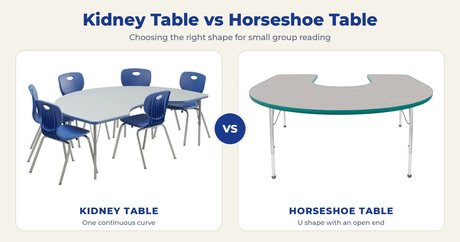
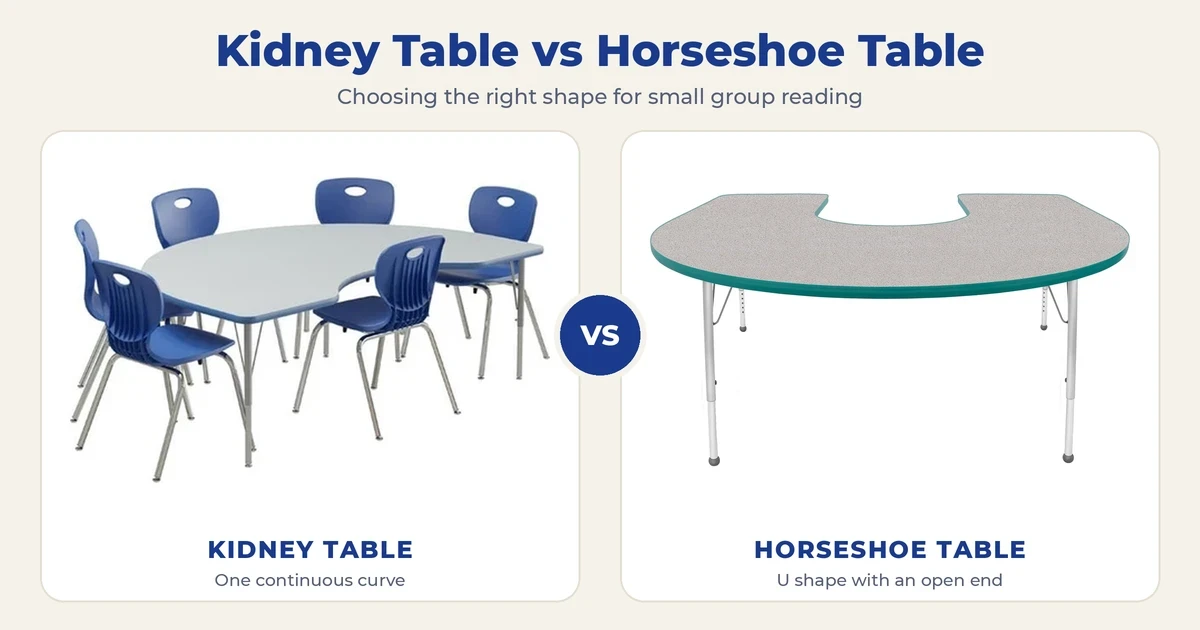
A kidney table has one continuous curve. A horseshoe table has three straight sides forming a U, with the teacher sitting in the open end. That difference changes where students face, how far the teacher has to reach, and what happens when the group grows from four students to six. A product photo does not show any of this.
This guide covers the comparison only. If you are still deciding whether either shape suits your room, our other guides cover that separately. Use this one once you have narrowed the choice to these two. For the fundamentals on why kidney tables work in small group teaching, see the kidney tables pillar guide.
The short version
Kidney tables suit teachers who stay seated and reach across a curved surface. Horseshoe tables suit teachers who move a little and work with students who need more elbow room. Neither shape is better than the other. The right choice depends on how you already teach.
How the two shapes differ
Start with what each shape does to a group of students sitting around it. That is the part of a classroom table shape comparison that is easiest to overlook when you are comparing product photos.
Kidney: one continuous curve
A kidney table's outer edge is one long unbroken curve. Every student around that curve sits about the same distance from the teacher on the inside, so the teacher can reach any student's paper with a small lean rather than a stretch.
Horseshoe: three straight sides, three seating zones
A horseshoe table has three flat sides forming a U. Students sit along those three sides, which creates three seating zones: left arm, middle base, right arm. Students on the arms face across the U toward each other, while students on the base face the teacher directly. Where a student sits changes how they take part in the lesson.
What the difference means in a lesson
On a kidney table, every student faces the teacher in roughly the same way. On a horseshoe table, students on the two arms sit at an angle to the teacher and to the other arm, while students on the base sit straight across. In discussion work where students respond to each other, the angled seating on the arms makes eye contact between students easier. In direct instruction where every student follows the teacher, the even seating on a kidney table keeps attention on the teacher. This seating angle is worth checking in any classroom table shape comparison, since it changes how much students talk to each other during a lesson.
Teaching modes each shape suits
A small group teaching table comparison becomes more useful once you match the shape to the teaching you do most often. The two shapes are not interchangeable across every mode.
Where kidney tables work well
- ●Direct instruction. Teacher demonstrates, students copy or respond. Every student sits the same distance from the teacher's demonstration surface.
- ●One-on-one conferences with quick group rotation. The teacher can turn from student to student without leaving the seat, since every student is within the same reach.
- ●Early literacy with shared texts. Every student sees the teacher's book or reference material from a similar angle when the teacher holds it up on the inside curve.
- ●Assessment work. The teacher can watch every student's paper during a running record or a math check with only a small turn of the head.
Where horseshoe tables work well
- ●Discussion-based small group work. Students on the arms can look at each other across the U, so they respond to each other without the teacher prompting every turn.
- ●Guided writing conferences. Each student has more elbow room on a flat edge than on a curved one, which helps when students are writing longer pieces on paper or a laptop.
- ●Group projects where students share materials in the middle. The opening in the middle of the U becomes a shared work area where materials sit within reach of the teacher and the group.
- ●Technology-heavy small groups. Laptops and tablets sit more stably on a flat edge, and the straight sides leave room to angle a screen without knocking the next student's device.
A simple way to compare the two
A kidney table puts the teacher in front of every student. A horseshoe table puts students in front of each other with the teacher present. Both are useful, and a small group teaching table comparison is easier once you decide which of the two you do more often.
How the shapes handle different group sizes
Group size affects the two shapes differently, and it is a practical point to check before ordering.
Small groups of three to four students
Both shapes work well at this size. The curve of a kidney table wraps closely around a small group. A horseshoe table can feel oversized, with seats left empty along one of the sides. For a typical group of three to four students, a kidney table is usually the better fit.
Standard groups of five to six students
Both shapes are sized around groups of five to six, and either one works well. The choice depends on teaching mode rather than seating capacity. A kidney table at this size still keeps all students within the teacher's reach. A horseshoe table uses all three sides without anyone feeling squeezed. At this group size, the kidney table vs horseshoe table choice usually rests on teaching style, since both shapes seat five to six students comfortably.
Larger groups of seven to eight students
The two shapes differ more at this size. A kidney table starts to feel stretched, with students at the ends of the outer curve sitting further from the teacher. A horseshoe table handles this size better, since the three straight sides spread students more evenly and no student sits at an awkward distance.
| Group Size | Kidney Table Fit | Horseshoe Table Fit |
|---|---|---|
| 3 to 4 students | Good fit, curve wraps closely | Works, but can feel oversized |
| 5 to 6 students | Good fit at this size | Good fit at this size |
| 7 to 8 students | Stretched, end seats sit further away | Better, seats spread evenly |
| Beyond 8 | Not recommended | Approaching capacity limit |
Build and construction differences
The two table types often differ in how they are built, and those differences affect daily use without appearing on a specification sheet. This teacher table shape comparison section covers the build-side points that are easy to overlook before the table arrives.
Edge banding and safety
Both shapes usually ship with rounded or radiused edges to reduce injury from bumps. A kidney table has a single continuous curved edge with no external corners, so the edge treatment runs uniformly around the whole perimeter. A horseshoe table has three straight edges meeting at two rounded corners on the outer face, plus the inner U cutout. Finish wear tends to appear first where two edges meet, so a horseshoe table has more of these points than a kidney table.
Adjustable height options
Adjustable height legs are available on both types across most manufacturer lines. The Mahar Scalloped Horseshoe Activity Table sold at Today's Classroom is one example of an ECO-certified horseshoe unit with adjustable height, and Allied USA offers adjustable height on their kidney line. If a shared room serves several grade levels, adjustable height is available on both shapes, so it is not the deciding factor between them.
Weight and movability
Kidney tables and horseshoe tables of similar size weigh about the same, but the shape spreads that weight differently. A horseshoe table carries its weight more evenly across the footprint, so one person can usually shift it without casters. The weight of a kidney table sits along one long axis, which makes it awkward for one person to move without help.
Storage integration
Neither shape usually comes with under-table storage as standard, so the storage add-ons differ. A kidney table works well with a rolling cart tucked against the outer curve. A horseshoe table works better with wall-mounted shelving behind the teacher, since the flat teaching edge sits parallel to the wall. Storage is worth including in a teacher table shape comparison, because it changes what the full setup costs. Our guide on kidney table classroom layout ideas covers storage placement in more detail alongside floor plans for small rooms.
How the two compare on price
Kidney tables and horseshoe tables of comparable size and quality sit in similar price ranges, though the two categories are stocked differently.
Kidney tables have a wider brand and price spread. Kidney is the more common shape in elementary classrooms, so more manufacturers make one, and there are more options at every price point. Horseshoe tables come from fewer manufacturers, so the range is narrower, and features such as scalloped edges or adjustable ECO-certified builds sit at the higher end of what is available.
| Price Positioning | Kidney Table Availability | Horseshoe Table Availability |
|---|---|---|
| Budget end | Wide selection across brands | Fewer options at the budget end |
| Mid range | Very wide selection | Solid selection |
| Higher end and specialty | Available across brands | Available but from fewer manufacturers |
| Adjustable height variants | Widely available | Available on most brands |
| Dry-erase or specialty tops | Widely available | Less common |
If the budget is tight, a kidney table gives you more options to shop within. If features such as scalloped safety edges or ECO certification matter, horseshoe tables narrow the choice but still cover those requirements. Neither shape costs more than the other at comparable spec levels.
Still not sure which shape fits your teaching? Tell us how your small group time runs: direct instruction, discussion, writing conferences, or something else. We can recommend kidney or horseshoe based on how you teach. Free, and no purchase required. Call 877-909-9910.
Get Free Classroom Layout PlanningThe case for having both in the same room
Some schools order both shapes for the same classroom or intervention room. The two shapes suit different teaching modes, and some teachers use both modes across a week.
A common setup pairs a kidney table for direct instruction and small group reading with a horseshoe table for guided writing conferences and discussion work. Both tables stay in the same room, and the teacher moves between them depending on the day's schedule. This costs more upfront, but it avoids asking one shape to cover every kind of small group work.
For most classrooms, one shape is enough. Two tables are worth considering when the room runs both direct instruction and discussion-based small group work as part of the daily routine.
Frequently asked questions
Do kidney and horseshoe tables use the same chairs, or do I need different seating for each?
They use the same chairs. Both shapes are sized around standard classroom chairs matched to the table height. If a room already has chairs for a kidney table, the same chairs work with a horseshoe table of comparable height. Schools ordering a second small group table do not need to buy seating again.
Can a horseshoe table be used with students on the inside of the U instead of outside?
Some teachers arrange it this way for specific activities, with the teacher on the outside and one or two students working inside the U. It is not the design intent, but it works for a task such as one-on-one reading assessment. The inside of the U is not big enough for a full group, so it suits occasional use rather than everyday teaching.
Which shape is easier to keep clean, especially with younger students?
Kidney tables are slightly easier because of the single continuous edge with no external corners. Crumbs, spills, and craft debris slide off a curved edge more predictably than off an edge with a corner. Horseshoe tables have two outer corners where debris collects, though those corners are usually radiused rather than sharp, so the difference is small.
Do reading specialists and interventionists have a strong preference between the two shapes?
Reading specialists and RTI interventionists often prefer kidney tables for guided reading and small group phonics, which are direct instruction modes. Speech-language pathologists and some special education teachers lean toward horseshoe tables when their work includes more discussion or collaborative activities. These are tendencies rather than rules, and preferences vary by teacher.
If I already have a rectangular table in the room, should I replace it with kidney or horseshoe?
It depends on what the rectangular table is used for now. If it is being used for small group instruction and not working well, either shape will suit that work better. If it is a general work surface for independent student projects, neither shape replaces it, since both are shaped for teacher-led small groups. The question is whether to replace the rectangular table at all, or add a small group table alongside it.
Keep reading
These guides cover the other decisions that come up alongside the shape choice.
- ●How to use kidney tables in a classroom: a complete guide. The pillar guide covering everything about kidney tables, from shape to cost.
- ●Kidney table classroom layout ideas for small rooms and reading groups. Where to put the table in your room, with four working scenarios.
- ●Kidney table size for classroom. Detailed sizing guide by group size and grade level.
Browse the full kidney tables and horseshoe tables ranges, and see how they fit alongside our full range of school classroom furniture at Today's Classroom.
Choosing Between Kidney and Horseshoe for Your Room?
Tell us how your small group time runs and what your room looks like. We match the shape to the teaching, not the catalog.