Kidney Table Size for Classroom: K-5 Sizing Guide
Posted by Today's Classroom Team on 8th Sep 2026
Getting the kidney table size for classroom use wrong can affect student posture and comfort. A table that is too high or too low makes it harder for students to sit in a comfortable working position. The difference may not seem serious during a short activity, but repeated use during reading groups and other small group sessions makes an appropriate table-and-chair fit important. If the height is wrong, students may shift, fidget, or struggle to settle.
Small group tables are often ordered on price and shape alone, without checking the height against the students who will sit at them. When the height is off, the table still gets used, but students may sit at the wrong angle during every session without anyone noticing that the table height is the problem.
This guide covers the table heights that match K to 5 students, the chair heights that pair with each table height, and how to choose between fixed and adjustable height when one table has to serve more than one grade level. For the fundamentals on why the kidney shape works in small group teaching, see the kidney tables pillar guide.
The 90-90-90 rule, applied to a kidney table
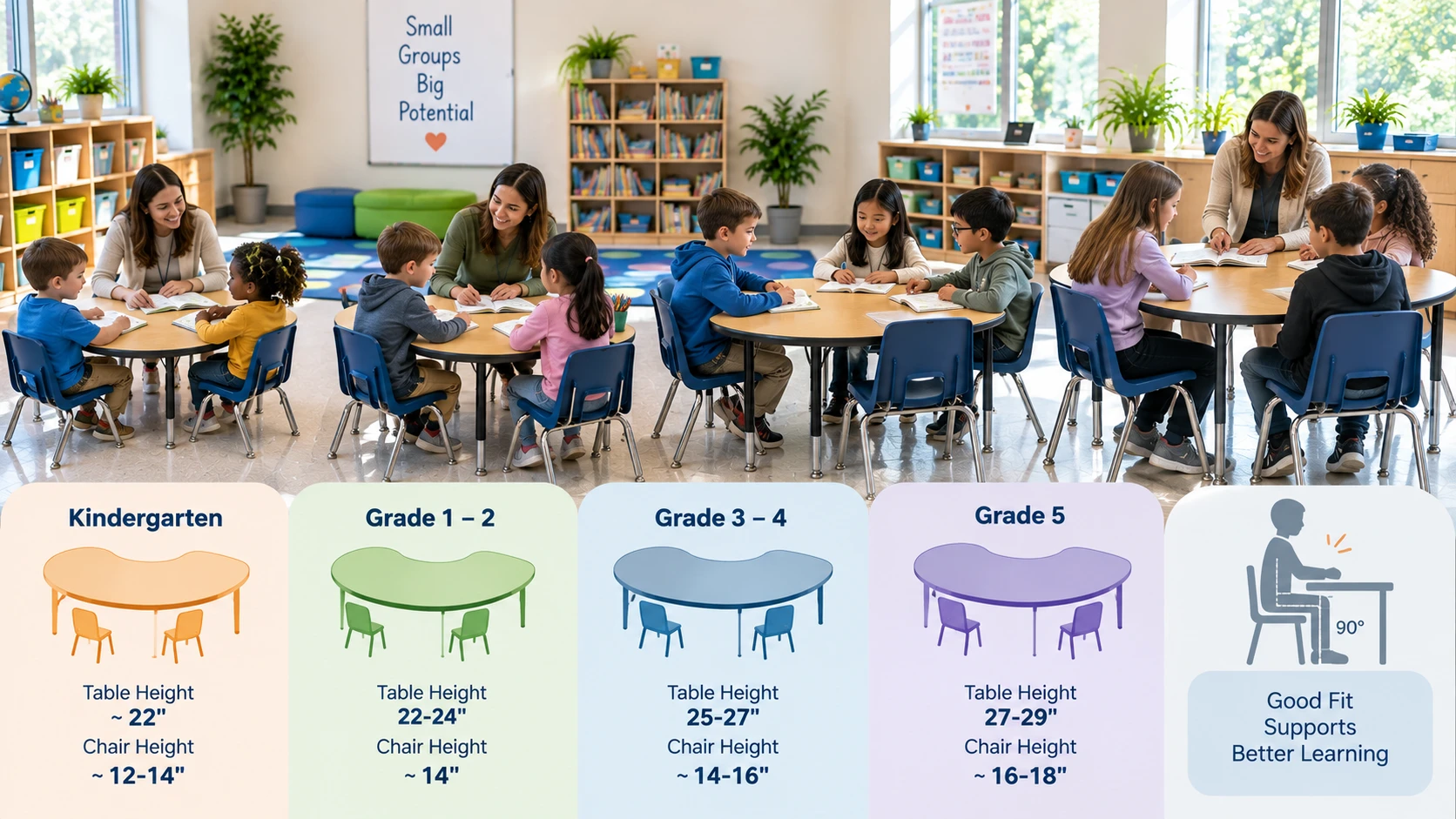
The 90-90-90 rule is a commonly used guideline for seated posture: knees, hips, and elbows each bent at roughly 90 degrees. Knees bent with feet flat on the floor. Hips bent with thighs parallel to the floor. Elbows bent with forearms resting on the tabletop. If a student cannot sit that way comfortably, the chair and table are probably not matched to them.
Grade-by-grade sizing chart for K to 5 kidney tables
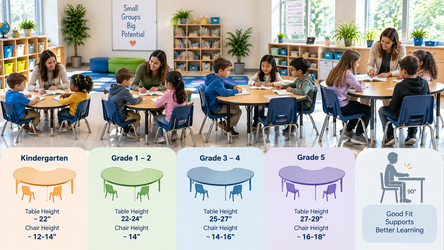
The chart below matches grade level to chair height and table height for elementary classrooms. Use these ranges as a starting point when planning a classroom kidney table dimensions order. The ranges below are starting points rather than universal requirements. Student height, existing chair dimensions, table construction, and manufacturer specifications should also be considered before ordering.
| Grade Level | Typical Age | Chair Seat Height | Table Height | Notes |
|---|---|---|---|---|
| PreK | 3 to 4 years | 10 to 12 inches | 19 to 20 inches | Consider 10-inch for smaller students |
| Kindergarten | 5 to 6 years | 12 to 14 inches | 22 inches | Consider more than one chair height if student sizes vary |
| Grade 1 to 2 | 6 to 8 years | 14 inches | 22 to 24 inches | 14-inch is a common starting point; check the fit |
| Grade 3 to 4 | 8 to 10 years | 14 to 16 inches | 25 to 27 inches | Sizes vary widely; consider more than one chair height |
| Grade 5 | 10 to 11 years | 16 to 18 inches | 27 to 29 inches | Approaching middle school proportions |
Two points before you use the chart. The ranges are wider at the younger grades because young children vary more in size than older students do. One kindergarten class can include students who need a 12-inch chair and students who fit a 14-inch chair. Student sizes also vary within a grade band, so those bands often work better with more than one chair height or an adjustable table.
The 8-inch rule for chair-to-table gap
The chair-to-table gap is another useful measurement to check at every grade level. A chair-to-table height difference of around 8 inches can be used as a starting point when pairing classroom chairs and tables, but the actual fit should be checked against the students and the furniture specifications.
This measurement is useful when a table and chair are close in size but do not quite match. A 14-inch chair with a 22-inch table gives you roughly that gap. The same chair with a 24-inch table leaves a wider gap, and students have to raise their shoulders when they write. Both are standard sizes, so check the pairing rather than each piece on its own.
A quick way to check the table and chair height
Sit a student in the chair and measure from the top of the seat to the tabletop. Use that height difference as a starting point, then check whether the student can sit with their feet supported and their forearms resting on the tabletop without lifting their shoulders. If the table feels too high or too low, adjust the chair or the table height where possible. The check takes about 30 seconds and can identify a mismatch before students spend months working at the wrong height.
Standard kidney table dimensions
Beyond height, kidney tables come in a few standard footprints. 48 by 72 inches is one size option for classroom kidney tables and can hold a small instructional group, depending on the manufacturer's design and stated seating capacity.
Compact kidney tables
Compact kidney tables are available in smaller footprints than 48 by 72 inches. Exact dimensions vary by manufacturer, so compare the product specifications against the space and group size you have available. They work well in early years rooms where groups are smaller and floor space is tight.
Standard kidney tables
48 inches wide by 72 inches long, and a common choice for K to 5 classrooms. It suits reading groups of five to six students, matches standard elementary chair heights, and fits most classroom layouts without moving other furniture around it. When comparing standard-size models, check classroom kidney table dimensions and stated seating capacity from the manufacturer, since both vary by design.
Larger kidney tables
Some manufacturers offer 54 by 84 or larger. These sizes are more common in art rooms, science rooms, and shared collaborative spaces than in K to 5 general classrooms. For small group reading and math instruction, a table larger than 48 by 72 means the teacher has to lean further or stand to reach students on the far side.
Fixed height versus adjustable height
You also need to decide between fixed and adjustable legs when planning a kidney table size for classroom order. The choice depends on how much the students using the table will change over the years the table is in service.
When to choose fixed height
A dedicated Grade 2 classroom with the same age group every year, and no plans to change grade levels, does not need adjustable legs. Fixed height tables usually cost less, have fewer parts, and have nothing that can loosen over time. If the room is used the same way each year, fixed height is the practical choice.
When to choose adjustable height
Rooms shared across grade levels, used by several teachers, or serving a range of student ages are better with adjustable legs. This covers intervention rooms, reading specialist offices, resource rooms, and any space where students from different grade levels may use the table over time. Adjustable tables vary in their adjustment range and adjustment increments, and some models offer a wide height range. Check the manufacturer's specifications to confirm whether the available range suits the students, or adults, who will use the table. Browse kidney tables with adjustable options to see what current models offer.
| Factor | Fixed Height | Adjustable Height |
|---|---|---|
| Upfront cost | Lower | Higher; pricing varies by model and manufacturer |
| Structural simplicity | Simpler, fewer moving parts | More components, requires occasional tightening |
| Grade flexibility | Locked to one grade band | Serves multiple grade levels in same unit |
| Room reassignment cost | Table may need replacement | Adjust legs, keep the table |
| Best for | Dedicated single-grade classrooms | Shared rooms, intervention spaces, growing programs |
Matching chairs and table heights
A common mistake is ordering the table first and then looking for chairs to fit it. Consider the chair and the table together. If chairs are already in the room, measure their seat height before selecting the table. If you are furnishing the room from scratch, choose a compatible table-and-chair combination based on student size and manufacturer specifications.
Use the grade-level guidelines in the chart above as a starting point for chair height, then pair a table height to it. When a room is being furnished from scratch, this order prevents the mismatch that happens when a kidney table size for classroom order goes out first, and the chairs are chosen later based on what is available rather than what best matches the table.
Buying chairs at the same time as the table
If the table order includes chairs, specify both in the same order, and the heights will match. If the chairs are already in the room, measure them before ordering the table. A 14-inch seat with a 24-inch table leaves a 10-inch gap, and students will feel it in every session.
Buying a table when chairs already exist
If the classroom already has usable chairs, measure them and add 8 inches to get the table height, then order to that height. An adjustable table is useful here, since you can set it to the exact height the existing chairs need rather than replacing the chairs.
Sizing decisions for specific use cases
Some rooms do not fit the grade-level chart. These four situations require different sizing considerations.
Mixed-age intervention rooms
Reading intervention rooms can serve Grade 1 through Grade 5 students in a single week. Fixed height sized to one grade will be wrong for the others. An adjustable table can be set to a suitable height for each group and changed between sessions as needed. A kidney table for small group instruction in a mixed-age room needs legs that can be adjusted.
Kindergarten transition classrooms
Kindergarten student sizes can vary considerably, so keeping more than one chair height in the room helps accommodate students who need a different seat height during the year, without changing the table mid-year.
Multi-grade rural or split-grade classrooms
Split-grade classrooms serving Grades 3 and 4 together, or Grades 1 and 2 together, are common in smaller schools. Use an adjustable table where appropriate, and provide compatible chair heights for the different student sizes in the room.
Special education classrooms with wheelchair users
A student who uses a wheelchair may need additional knee and arm clearance beneath the tabletop. Confirm the required clearance against the student's mobility equipment and the accessibility requirements that apply to the space before ordering. An adjustable table set toward the top of its range is usually the practical option.
How many students fit at each kidney table size
Manufacturer seating numbers count chairs rather than working space. The table below sets out what to check at each common size when you are choosing a kidney table for small group instruction.
| Table Size | Typical Use | Planning Consideration |
|---|---|---|
| 36 by 60 inches (compact) | Smaller instructional group | Confirm manufacturer seating capacity |
| 42 by 66 inches | Small instructional group | Allow space for materials and teacher access |
| 48 by 72 inches (standard) | Standard small-group setup | Compare stated capacity with actual group needs |
| 54 by 84 inches (large) | Larger collaborative group | Confirm the larger footprint still allows clear room circulation |
Manufacturer seating capacity should be treated as a starting point. When planning a small group, also allow for the space needed for books, manipulatives, teacher access, and comfortable student movement. Our guide on kidney table classroom layout ideas covers the floor space each table size actually needs once chairs, teacher access, and walking paths are included.
Need help matching table size to your specific grade and room? Send us your grade level, your typical group size, and your room dimensions. Our Project Team will recommend a table size and chair pairing to suit them, before you order. Free, and no purchase required. Call 877-909-9910.
Get Free Classroom Layout PlanningFrequently asked questions
If a student is unusually tall or short for their grade, should we accommodate them individually?
Yes. In most cases, changing the chair is easier than replacing the table. Keep more than one compatible chair height available when student sizes vary, so a student who needs a different seat height can use the chair that fits best. The table stays the same and only the chair changes, which costs far less than keeping several tables at different heights in one room.
What is the actual weight capacity of a standard K to 5 kidney table?
Weight capacity varies by table construction and manufacturer. Check the manufacturer's stated weight capacity before placing heavy equipment on the tabletop or choosing a table for specialized use, such as holding a class set of tablets.
Do kidney tables need to be re-sized every year as students grow?
The table itself does not, but the chair pairing might. Student height can change over the school year, so check periodically whether the existing chair and table pairing still fits comfortably. If the table is adjustable, you can raise it, though changing chairs is usually faster and cheaper.
Is it possible to buy a kidney table sized specifically for adult use in a professional development or teacher training space?
Yes. Adult-height kidney tables are used in teacher training rooms, curriculum development spaces, and staff meeting rooms. Adult tables run around 29 to 30 inches tall, which is at the top of the range most adjustable classroom tables reach. Some manufacturers make dedicated adult-height models. Ask for adult sizing when you order, since a kidney table order is otherwise assumed to be K to 12 sizing.
What happens if the sizing is slightly off, is it worth reordering?
For a mismatch of one inch or less, changing the chair usually fixes it without reordering the table. A mismatch of two inches or more can make the table noticeably uncomfortable for students. The options are a different chair height, an adjustable chair set to match the table, or resetting the table if it adjusts. Reordering the table is a last resort, since the fix is usually available at the chair level.
Keep reading
These guides cover the other decisions that come up alongside sizing.
- ●How to use kidney tables in a classroom: a complete guide. The pillar guide covering everything about kidney tables, from shape to cost.
- ●Kidney table classroom layout ideas for small rooms and reading groups. Where the table goes in your room once you have chosen the right size.
- ●Kidney table vs horseshoe table for reading groups. If you are still deciding between shapes before locking in size.
Browse the full kidney tables range in every available size, and see how they fit alongside our full range of school classroom furniture at Today's Classroom.
Sizing a Kidney Table for Your Classroom?
Send us your grade level, typical group size, and room dimensions. We match table height, footprint, and chair pairing to the students who will use it.