Kidney Table Classroom Layout Ideas for Small Rooms and Reading Groups
Posted by Today's Classroom Team on 8th Sep 2026
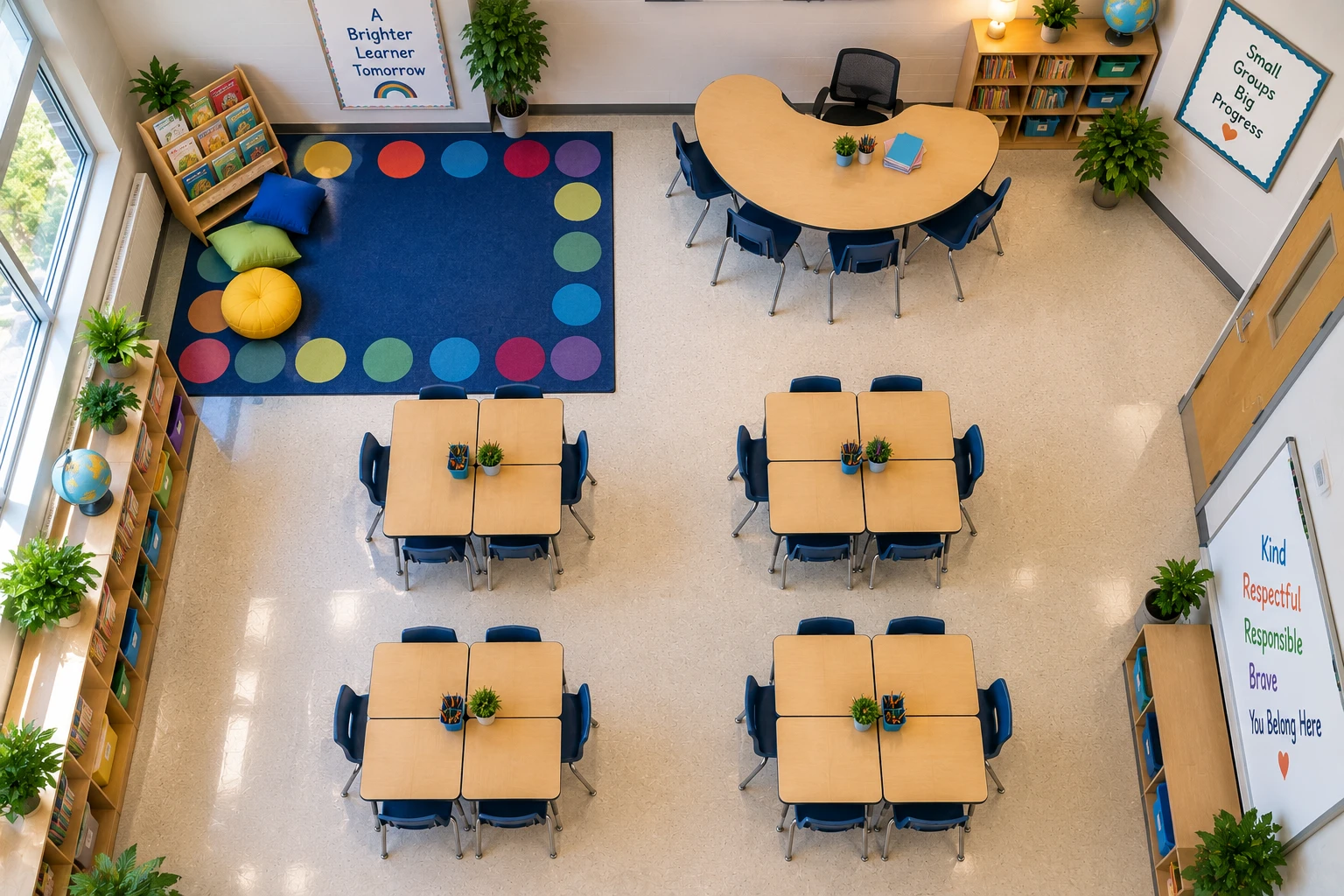
A good kidney table classroom layout starts with the space you have available. Plan for the table, chairs, teacher access, and clear walking paths before deciding where the table will go. Consider the table's size, where students will sit, and how the table fits with the rest of the classroom furniture.
Most layout problems are caused by three common issues: too little space around the table, poor visibility of the rest of the classroom from the teacher's seat, and storage that was not considered when planning the layout. All three can be addressed before the table arrives, but they are much harder to fix once everything is in place.
This guide covers layout ideas for small classrooms, shared spaces, and awkwardly shaped rooms. Each layout is based on a specific space or classroom need. For the fundamentals on why the kidney shape works and how to size and specify the table itself, see our pillar guide on how to use kidney tables in a classroom.
Before you sketch anything
Measure the room before you plan anything. Note the walls, doors, windows, radiators, outlets, and anything else fixed in place. Rooms rarely match the dimensions you have in your head.
The space a kidney table needs beyond its own dimensions
A 48-inch by 72-inch kidney table needs more space than its dimensions suggest. You also need room for students to pull out their chairs, space for the teacher to sit and move in and out, and clearance for people to walk around the table. For planning purposes, allow additional floor space around the table for chair movement, teacher access, and walking paths. The exact footprint depends on the table dimensions and the surrounding furniture.
A table may fit within the available floor space, but that does not mean the surrounding area will be usable. Once chairs, teacher access, and clear walking paths are included, the space becomes tighter than expected.
| Element | Space Needed | Why |
|---|---|---|
| Table itself | 48 by 72 inches | The stated table size |
| Chair pull-out on outer curve | About 30 inches deep | Students need to sit down, stand up, and shift chairs during a lesson |
| Teacher entry to inside curve | Enough clearance for the teacher to enter and leave the teaching position without moving student chairs | The teacher walks in and out of the teaching seat many times a day |
| Walking path if room traffic passes by | About 36 inches wide | Provides a clear route around the table when classroom traffic passes nearby |
| Total working footprint (approximate) | 60 by 96 inches | The real space to plan around |
If a room cannot spare that working footprint, a smaller kidney table is a better answer than squeezing in a standard size. Compact versions work well for early years classrooms and reading corners where the group is smaller. A small classroom reading group setup usually works better with a compact table than with a cramped standard one.
Layout scenarios for a small classroom
Classroom layouts vary, but there are four common ways to position a kidney table in a small classroom. The best option depends on the shape of the room, the other furniture, and how the space is used through the day.
Scenario 1: Against the back wall, rug to the side
This is one of the most practical layouts for kidney tables for classrooms. Place the table against the back wall, with the curved side facing the room. A reading rug can sit beside the table, allowing students to move between the two areas without crossing the main walkway. The teacher sits on the inside of the curve, facing the room, which also makes it easier to keep an eye on the rest of the class during small-group instruction.
This layout can work well in rectangular classrooms, because placing the table against a wall can preserve more open floor space than positioning it in the middle of the room. It also gives you a place for storage or a whiteboard behind the teacher, which keeps teaching materials close by without using additional floor space.
Scenario 2: Corner nook, storage on the adjacent wall
Place the kidney table in a back corner, with the outer curve along one wall and one end near the second wall. Storage shelving on the adjacent wall keeps frequently used materials close to the teaching seat. This kidney table placement uses two walls at once, which is what makes it work in rooms where floor space is tight.
This works particularly well in classrooms with an awkward corner that is difficult to use for other furniture. Placing the kidney table there makes better use of the available space, while the wall behind the teacher can be used for storage. This can be especially useful in smaller elementary classrooms where every bit of floor space matters.
Scenario 3: Away from the wall, near the window
This layout is less common, but it can work well in the right classroom. Place the kidney table far enough from the window wall to keep a clear walking path and easy access to the table, with the curved side facing the windows. This gives students natural light while they work and can make the reading area feel more open than a table against a wall.
The main consideration is space. Leaving room between the table and the wall uses more floor space than placing the table against a wall. This layout works best in larger classrooms or where natural light is an important part of the learning space.
Scenario 4: Facing the door, back to the whiteboard
Place the kidney table so the teacher faces the classroom door during small-group instruction. This allows the teacher to see students and staff entering the room without having to turn around. It can be useful in classrooms where students regularly leave for other activities or where aides, therapists, or support staff come in throughout the day.
The main limitation is the teacher's position relative to the whiteboard. With their back facing the board, this layout is better suited to small-group activities that do not require students to follow what is happening at the front of the classroom.
Placement in shared spaces and multipurpose rooms
A kidney table in a shared room has to work for more than one teacher, one grade level, and often more than one subject in the same day. That changes what makes a good layout, and it makes storage and height adjustment more important than they are in a single-teacher classroom.
Multiple teachers, one table
Adjustable-height legs are especially useful for a kidney table in a shared room. A table set for younger students may not provide the same working height for older students during an intervention session. Some manufacturers offer several height settings across different table sizes, which gives teachers more flexibility when the same kidney table is used by different age groups.
Storage is also important when several teachers share the kidney table. Each teacher needs easy access to their own materials without taking up space meant for someone else. Small labeled bins or a rolling cart with separate sections keep materials organized and make the table easier for everyone to use through the day.
RTI and MTSS pull-out rooms
Response to Intervention and Multi-Tiered System of Support rooms have specific layout needs. Students pull out from their regular classroom for short blocks of small-group instruction, so the room needs to settle quickly. A kidney table positioned where arriving students can easily see and reach their seats makes transitions simpler than a setup that requires students to navigate around furniture.
Multipurpose rooms shared across grade levels
Consider color coding. Some schools use tables in different colors to designate learning centers or grade level zones. If the room hosts a Grade 1 reading group in the morning and a Grade 4 math intervention in the afternoon, a color-coded system helps everyone know which materials belong at which table without having to relabel or explain it every session.
Layouts for awkward room shapes
Not every classroom is a clean rectangle. Portable buildings, converted rooms, add-ons, and older buildings often have shapes that make standard layouts hard to apply. In these rooms, the curved shape can be easier to fit than a rectangular table.
Long narrow rooms
Kidney tables work well in long narrow rooms because they use vertical wall space more efficiently than a round or rectangular table of similar seating capacity. Place the outer curve against a long wall, and the table's length runs parallel to the room rather than across it, which keeps the walking path down the middle clear.
L-shaped rooms
The inside corner of an L-shape is often the best spot for a kidney table. The corner takes the table's longest dimension, and the two adjacent walls can be used for storage. The teacher gets a semi-enclosed teaching area.
Rooms with columns or fixed structural obstacles
If the room has a column or another fixed obstacle, consider positioning the table nearby so the obstacle becomes part of the boundary of the small-group area. That turns dead space into part of the layout and separates the small-group area from the rest of the room without a divider.
One rule for awkward rooms
Do not fight the room. Whatever shape or obstacle the room gives you, use it as a boundary rather than trying to hide it. A curved table often fits an awkward corner better than straight-edged furniture.
Storage that works alongside the table
The pillar guide covers keeping storage within arm's reach. This section covers the specifics, since good kidney table classroom layout ideas also need a practical storage plan so frequently used materials do not take over the table.
The rolling cart approach
A three-tier rolling cart beside the teaching seat is a practical way to keep materials close by. You can dedicate separate tiers to frequently used materials such as guided reading books, math manipulatives, and phonics materials. The cart can be moved aside when the table is not in use and brought back for the next small group.
Wall shelving above and behind
Shallow wall shelves above the storage behind the teaching seat provide extra storage without taking up floor space. They are useful for reference books, spare materials, and other items the teacher may need occasionally but not during every lesson.
Under-table storage
Some kidney table models come with a shelf underneath the tabletop. If yours has one, use it for materials students need during group work, such as counters, dice, small whiteboards, or reading books. Keep the materials the teacher uses most often near the teaching seat instead of under the table.
| Storage Type | Best For | Position |
|---|---|---|
| Rolling cart | High-turnover materials the teacher accesses every lesson | Beside the teaching seat, on the teacher's dominant hand side |
| Wall shelves | Reference materials and less frequent items | Behind the teaching seat, at reachable height |
| Under-table shelf | Student-accessed materials during group work | Below the tabletop, if the model includes one |
| Nearby cabinet | Bulk supplies and rotating materials | Adjacent wall, within a few steps of the table |
Common layout mistakes and how to fix them
A few patterns come up in classrooms where a kidney table is in place but does not work as well as it could. Each has a straightforward fix, and addressing these issues early makes the table easier to use throughout the school day. Each one is worth checking in a small classroom layout for kidney table use.
Mistake: table faces a busy walkway
Students sitting on the outer curve become distracted by every person who walks past. Fix by rotating the table so the outer curve faces a wall or a low bookshelf, using the physical barrier to reduce visual distraction.
Mistake: storage across the room
Teacher has to get up from the teaching seat every few minutes to retrieve something. Fix by moving all frequently used materials to within arm's reach, even if it means adding a small cart or shelf specifically for the table zone.
Mistake: chairs blocking the teacher's exit path
The teacher cannot leave the teaching seat without asking students to move their chairs. Fix by keeping at least one end of the inside curve clear enough for the teacher to leave the teaching position without moving student chairs.
Mistake: table used for everything
A kidney table treated as a general-purpose surface fills up with random materials and stops working for small-group instruction. Fix by protecting the table for its primary use and finding a different surface for storing rotating classroom materials.
Sample layouts by classroom size
The room size drives a lot of the layout decisions. Here are working kidney table classroom layout ideas mapped to common classroom size ranges you might be working with, so you can start from the one closest to your actual room and adjust from there.
| Classroom Size | Starting Point | Layout Consideration |
|---|---|---|
| Under 600 sq ft | Consider a compact table | Prioritize corner placement and clear traffic paths |
| 600 to 800 sq ft | Consider a standard-size table if clearance allows | Back-wall placement can preserve open floor space |
| 800 to 1000 sq ft | Standard or larger, depending on furniture | More placement flexibility |
| Over 1000 sq ft | Standard or larger, depending on group needs | Multiple small-group zones may be possible |
Use room size as a rough guide. A cluttered 900 square foot room can feel tighter than a well-organized 700 square foot room, so adjust based on how much floor is available once desks, storage, and traffic paths are accounted for.
Not sure which layout fits your specific room? Send us your room dimensions and a sketch of your current furniture. Our Project Team can help you plan kidney table placement, chair clearance, and traffic paths before you order. No purchase required. Call 877-909-9910.
Get Free Classroom Layout PlanningFrequently asked questions
Can two kidney tables be placed in the same classroom?
Yes. This comes up in Grade 1 and 2 classrooms where two teachers, or a teacher and an aide, run parallel small groups. One option is to place the tables on opposite sides of the room, leaving a clear central path between them. Adjust the orientation based on teacher sightlines, student movement, and the rest of the classroom furniture.
How much does it cost to reconfigure the room if a kidney table layout does not work after a few weeks?
The furniture itself does not cost anything to move, but the time cost is real. The time required depends on the room, the amount of furniture involved, and whether the table needs to be moved or taken apart. Planning the layout before ordering reduces the need for later rearrangement.
Do kidney tables need to be near an electrical outlet?
Not always, but increasingly yes. If the small-group work involves tablets, listening centers, or any powered device, having an outlet within reach of the table saves running extension cords across walking paths, which becomes a trip hazard. Factor outlet position into layout planning if any technology use is expected at the table.
Can a kidney table double as a teacher desk when not in use for small groups?
It can, and some teachers use it this way, but there is a downside. A kidney table used as a teacher desk fills up with the teacher's own materials, which have to be cleared away before every small-group session. This works when the small-group schedule is predictable and the desk stays reasonably clear. It stops working when the desk role takes over and the table is no longer free for small groups.
What about layout for a special education or self-contained classroom?
Special education classrooms can benefit from a kidney table, since small-group and one-on-one instruction are often part of the daily routine. When planning kidney table layouts in classroom settings, the same basic layout principles apply, but you also need extra space for students who use walkers, wheelchairs, or standing frames. Allow additional clearance around the table based on the mobility equipment in use and the accessibility requirements for the space.
Keep reading
These guides go deeper on other decisions that come up alongside layout.
- ●How to use kidney tables in a classroom: a complete guide. The pillar guide covering everything about kidney tables, from shape to cost.
- ●Kidney table vs horseshoe table. How the two shapes compare for small-group setup.
- ●Kidney table size for classroom. Detailed sizing guide with group size and grade level breakdowns.
Browse the full kidney tables range, and see how they fit alongside our full range of school classroom furniture, at Today's Classroom.
Planning a Kidney Table Layout for Your Room?
Send us your room dimensions and a sketch of your current furniture. We map placement, chair clearance, and traffic paths so the layout works from day one.