
Why Your Classroom Easel Sits Unused (and the Fix)
Posted by Today's Classroom Team on 22nd Jul 2026
A classroom easel not being used is usually a sign that it wasn't the right fit for the classroom, not that it was a poor-quality product.
This guide explains how to choose a teacher easel that fits your classroom, teaching style, and daily lessons, so it becomes something you actually use instead of something that sits in the corner.
Already own one, and it is unused right now?
Skip ahead to the diagnostic further down. It will help you figure out in under two minutes whether the fix is a new routine, a new spot in the room, or a genuinely different configuration.
The three real reasons an easel goes quiet
A classroom easel usually doesn't go unused because of one big problem. More often, it's a series of small issues that make it less convenient to use than the classroom whiteboard. In most cases, three common mistakes explain why an easel ends up being used far less than expected.
It duplicates something the room already has
If the easel is used the same way as the classroom whiteboard, there's often little reason to use it. The whiteboard is already in place, larger, and familiar to both teachers and students. Unless the easel serves a different purpose, it often gets used much less.
Nobody decided what its one job actually is
An easel is more likely to get used when it has a clear job. It might be the place for morning messages, anchor charts, small-group lessons, or classroom schedules. Without regular use, it's easy for the easel to be forgotten while teachers stick with the whiteboard they're already using.
It became a landing spot for stuff
Storage tubs and classroom supplies have a way of piling up. Once an easel starts being used for storage, teachers have to clear it off before they can use it. Over time, many simply use the classroom whiteboard instead.
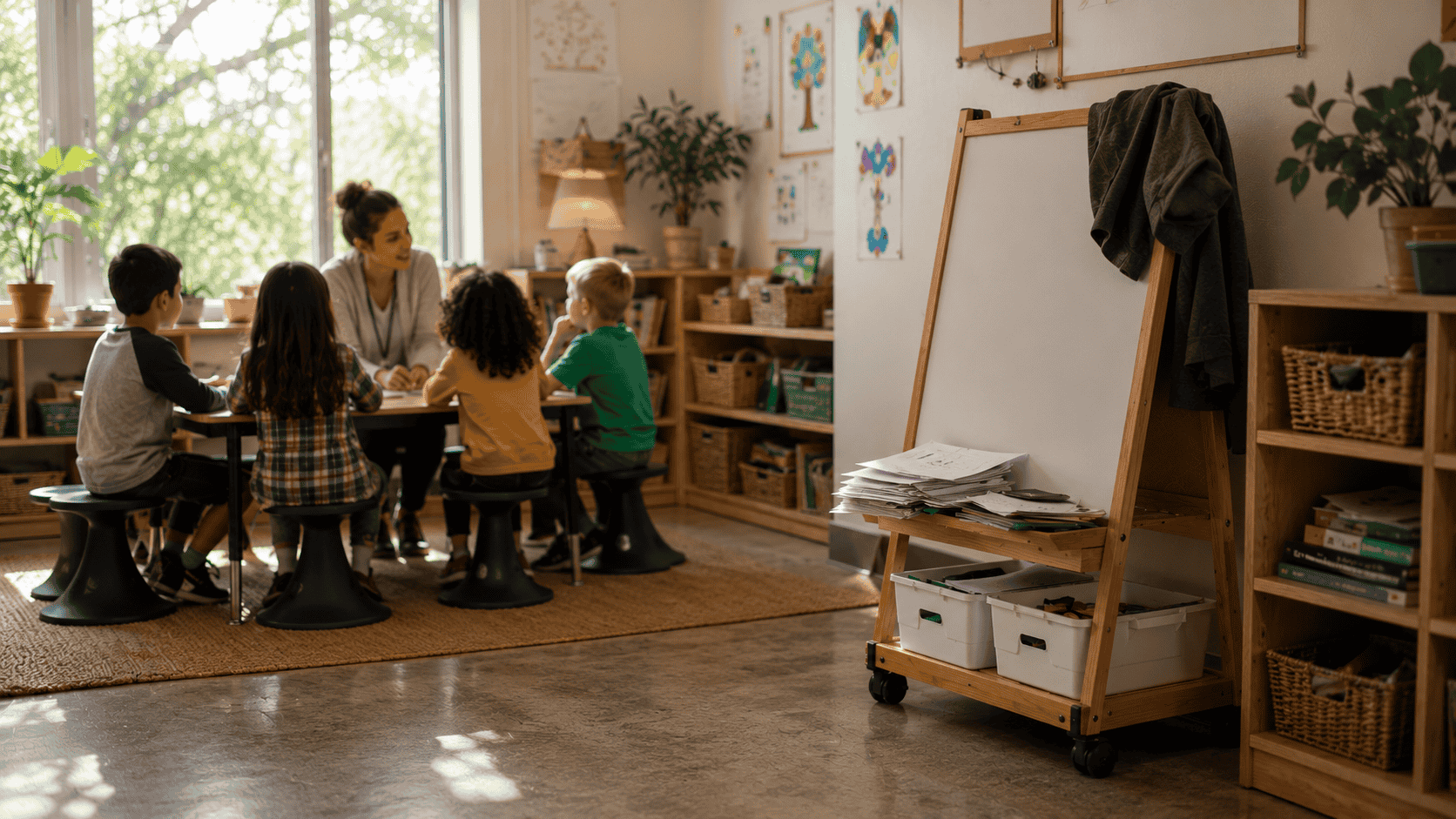
This easel is easy to wheel around my third grade classroom where I use it to create anchor charts during mini lessons and as a whiteboard at our back table during small group instruction.
Laura Santos, third grade teacher, California
How to use a teaching easel so it becomes a habit, not a decision
The most-used easels have a clear purpose. Whether it's for morning messages, anchor charts, or small-group lessons, using the easel for the same tasks each day makes it part of the classroom routine. Understanding how to use a teaching easel this way starts with attaching it to something that already happens on a fixed schedule.
Anchor it to a recurring block, not whenever
A morning message that happens at the same place every day. A small group rotation that runs on a set schedule. A weekly writing mini-lesson. Pick something with a fixed slot on your schedule and make the easel that activity's permanent home. Once a routine has a fixed time and a fixed tool, it survives busy weeks that a flexible, whenever-I-remember habit does not.
Build charts with students, not for them
Creating anchor charts with students during a lesson makes them more meaningful because the class helps build them together. An easel makes this easy by giving teachers a place to write and display the chart without having to clear wall space first. When the lesson is over, the chart can stay on the easel for students to refer back to.
Rotate what is on it
A chart that has been on display since the start of the school year is easy for students to overlook. Replacing charts as each unit changes keeps the information relevant and gives students something new to refer to. If you teach in units, updating the easel at the start of each one is an easy routine to follow.
| Day | Suggested easel task | Time |
|---|---|---|
| Monday | Build the week's focus anchor chart with the class | 10 minutes, morning meeting |
| Tuesday to Thursday | Small group rotation surface | 15 to 20 minutes per group |
| Friday | Review chart, add student contributions, retire if unit is ending | 5 minutes, closing circle |
The three storage zones that keep an easel from becoming clutter
Storage can make an easel more useful, but only if it holds the supplies used with the easel. Once it becomes a place for extra classroom materials, teachers often have to clear it before each lesson, and it gets used less. Keeping storage organized by purpose helps the easel stay ready to use.
Front and active surface. Keep this completely clear except for what the current lesson needs. Nothing lives here permanently.
Task-specific storage. Tubs or shelves hold only what supports the easel's one assigned job: markers for the current chart, cards for the current small-group activity. Anything unrelated does not belong here, no matter how convenient the space looks.
Everything else. Bulky or rarely used items get a different home entirely, even if that means a slightly longer walk to fetch them. An easel loaded with unrelated supplies stops looking like a teaching tool and starts looking like a shelf, and once it looks like a shelf, it gets treated like one, which is exactly how a perfectly functional board turns into underused classroom furniture without anyone deciding that on purpose.
A two-minute diagnostic before you assume it is the easel's fault
Before deciding an easel was simply a bad purchase, run through this. Most unused easels trace back to one of these four answers rather than a defect in the product itself.
| Ask yourself | If yes, the likely fix |
|---|---|
| Does it duplicate what my main whiteboard already does? | Give it a distinct job the main board cannot do |
| Is its storage full of things unrelated to one task? | Clear it down to one small, task-specific kit |
| Is it positioned somewhere I rarely stand or teach from? | Move it within arm's reach of where you already teach |
| Does it need to travel but cannot roll where I need it? | Check the configuration; this may be a mobility mismatch, not a routine problem |
The last point is often the most important. Sometimes the issue is not how the easel is being used, but whether it was the right type for the classroom in the first place. For example, a wall-mounted easel is a poor fit for a classroom where lessons move between different areas. In that situation, no amount of planning or routine will make it more useful. Choosing the right configuration from the start is often what determines whether a classroom easel gets used every day.
Not sure if it is a routine problem or a configuration problem? Send us your grade level and how your room actually runs across a day. Our Project Team can tell you honestly whether a different setup would solve it. Free, no purchase required. Call 877-909-9910.
Get a Free Classroom ReviewFrequently asked questions
Is it normal for a new easel to take a few weeks before it feels natural to use?
Yes, and this is worth knowing before assuming something is wrong. Any new piece of classroom equipment competes with habits that are already automatic, so a two to three week adjustment period where you have to consciously remember to use it is completely normal. If it still feels effortful after a month, that is the point to look at routine and placement rather than waiting longer.
Should students be allowed to use the easel independently, or only the teacher?
This depends entirely on the surface and the age group, and it is worth deciding on purpose rather than by accident. In primary grades, giving students supervised turns at the easel during centers or partner work builds ownership and often increases how often it gets used overall, since students start requesting it. In upper grades, a teacher-only policy for the main instructional surface, with a separate small whiteboard or clipboard for student use, usually works better and avoids wear on the primary teaching surface.
What if two teachers share one classroom and disagree on how to use the easel?
Co-taught and shared classrooms are actually where easels get underused most often, because without a clear owner for the routine, both teachers assume the other one is handling it. The fix is simple but rarely done: assign the easel's recurring task to one specific teacher and one specific time block, the same way you would assign any other classroom job. Shared ownership without a specific owner tends to default to nobody.
Does moving classrooms or switching grade levels each year affect whether an easel stays in use?
It does, more than most teachers expect. A routine built around one classroom's rhythm does not automatically transfer to a new room or a new grade level, which is why an easel that was in constant use suddenly goes quiet after a summer move. Treat a room change as a reason to rebuild the routine from scratch rather than assuming the old habit will simply continue in the new space.
Keep reading
These guides cover the decisions that come before and after the routine question.
- ●Teacher Easels for the Modern Classroom. The complete buying guide covering every type, size, and price point.
- ●Mobile or Wall-Mounted Easels for Classrooms. If the diagnostic above pointed to a mobility mismatch, this covers how to fix it.
- ●Double-Sided vs Single-Sided Teacher Easels. Whether a second surface would actually get used in your room, or just add cost.
Browse the full teacher easels range, and see how school classroom furniture fits together as a full room plan.
Not Sure If It's Your Easel or Your Routine?
Send us your grade level and how your room runs day to day. We will tell you honestly whether the fix is routine, placement, or configuration.