Double-Sided vs Single-Sided Teacher Easels
Posted by Today's Classroom Team on 24th Jul 2026
The double-sided vs single-sided teacher easel question usually comes down to one thing: will both sides actually be used? If the answer is no, a single-sided easel is often the better buy.
This guide compares single-sided and double-sided teacher easels, explains the real price differences, covers the removable felt board included with the single-sided model, and helps you choose the right option for different classrooms and teaching styles.
The short version
If two people or two groups genuinely need to write on the easel at the same time, double-sided earns its cost. If one teacher runs one flow at a time, single-sided covers the same daily work for less, and the felt board on the back still gives you a second surface type without a second price tag.
What double-sided and single-sided actually give you
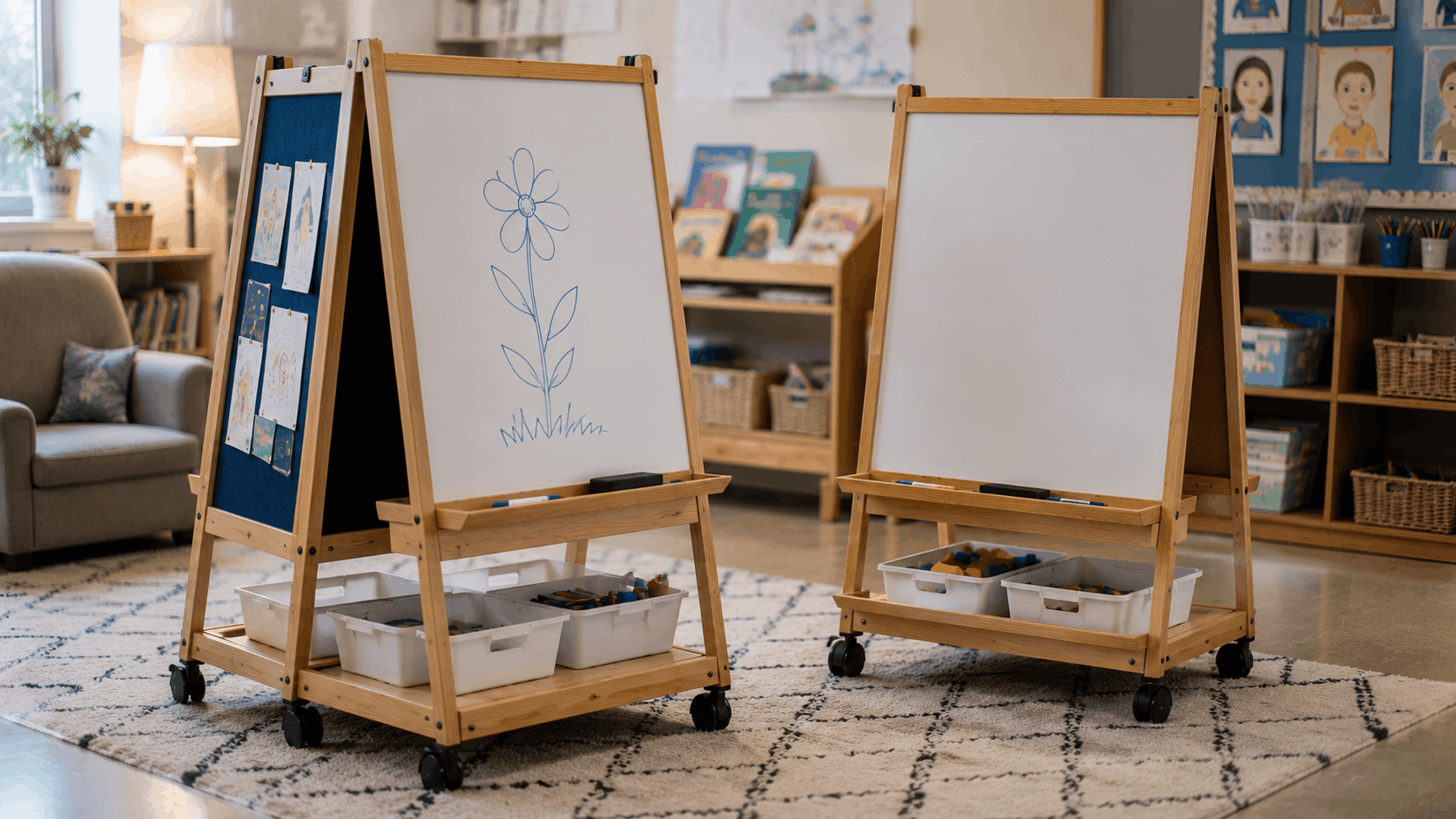
A two-sided classroom easel provides two writing surfaces, so teachers can keep one lesson on each side or switch between activities without erasing the board. The Copernicus BE1 Bamboo Double-Sided Teaching Easel includes two 29 x 29-inch magnetic dry-erase boards, four storage tubs, a lockable book ledge, and a 59-inch bamboo frame with 3-inch locking casters.
A single-sided easel provides one writing surface, making it a good choice for classrooms that don't need two boards. The Copernicus PTE78 Primary Teaching Easel ($294.41) features a 40 x 28-inch magnetic whiteboard, giving teachers more writing space than either board on the double-sided model.
This easel is easy to wheel around my third grade classroom where I use it to create anchor charts during mini lessons and as a whiteboard at our back table during small group instruction.
Laura Santos, third grade teacher, California, reviewing the Copernicus Bamboo Teaching Easel
The detail most orders miss: the felt board on the back
One feature that's easy to overlook is the removable felt board on the back of the Copernicus PTE78. While the front has a single magnetic whiteboard, the reverse side accepts a felt board for Velcro-backed teaching materials such as word cards, picture sorts, phonics tiles, and other literacy resources.
That means a budget teacher easel like the PTE78 gives you a writing surface on the front and a display surface on the back, just not two writing surfaces running at once. For reading and literacy instruction specifically, that split often works better than two matching whiteboards, since the felt board handles material display while the front board handles live writing, and neither competes with the other for the same job.
The double-sided model replaces the felt board with a second magnetic dry-erase board. The choice comes down to how the easel will be used: two writing surfaces, or one writing surface paired with a felt display board.
Real pricing across the Copernicus range
Every model in this comparison ships through Today's Classroom with the same warranty terms and purchase order process, so the decision genuinely comes down to configuration and price.
| Model | Surface | Price |
|---|---|---|
| Copernicus BE1 | Double-sided, two dry-erase boards | Around $400 |
| Copernicus PTE78 | Single-sided, dry-erase front, felt back | Around $300 |
| Copernicus ELS1 | Double whiteboard, foldable frame | Around $300 |
| Copernicus RC201 | Single-sided, compact, repositionable tubs | Around $300 |
The price difference between the BE1 and PTE78 is around $100 to $120 per easel. That may not seem like much when buying one unit, but it adds up quickly. For example, ordering five easels increases the cost by about $500, money that could be used for other classroom supplies or equipment.
When the second surface earns its cost
There are three situations where a two-sided classroom easel is worth the extra cost. In each case, both writing surfaces are used regularly, making the additional expense worthwhile.
- ●Co-teaching, two groups, same time. Two teachers, each running a group simultaneously from the same easel, means both surfaces are working at once. This is the exact use case the double-sided design solves.
- ●Back-to-back rotations with different content. Prepare both sides before the lesson starts, with one activity on the front and the next on the back. As groups rotate, turn the easel instead of erasing and rewriting the board, helping lessons move from one group to the next with less interruption.
- ●Shared classroom easel across adjacent teaching pods. In some newer school layouts, two classrooms or teaching areas share a common space. A double-sided classroom easel placed between them gives each teacher a writing surface without moving the easel.
The real test before you buy double-sided
Think back over the last full week of teaching. Was there a moment you genuinely needed a second working surface because the front of the easel was already in use for something you could not erase yet? If yes, the second surface solves a problem you actually have. If you cannot picture that moment, it likely will not.
When single-sided is the smarter spec
Most self-contained K-5 classrooms use one easel for one lesson at a time. Teachers write, teach, erase the board, and prepare for the next activity. If that's how your classroom works, a budget teacher easel can provide everything you need without paying extra for a second writing surface.
A single-sided easel is also a good choice when it's shared between classrooms or used by teachers who move from room to room. It's lighter to move, and most lessons only need one writing surface.
Which configuration fits your room
Match your own room against these patterns rather than guessing from price alone.
| Your room does this: | Best fit: |
|---|---|
| One teacher, one flow at a time, whole and small-group across the day | Single-sided, the second surface rarely runs simultaneously |
| Two co-teachers, each running a separate group at the same time | Double-sided, both surfaces genuinely in use together |
| Reading intervention needing both a writing surface and a display board | Single-sided with felt back, covers both without paying for two whiteboards |
| Specialist teacher rotating across multiple rooms | Single-sided, lighter and simpler to transport |
| Tight budget, ordering four or five units for a grade level | Single-sided, the savings compound fast across multiple units |
| New build with two teacher pods sharing one instructional zone | Double-sided, built exactly for this layout |
Ordering and budget planning
Every model here accepts a school purchase order at checkout with no credit card required. For grade-level or building-wide orders, the Project Team can confirm the right mix of single and double-sided units across multiple rooms before anything ships, and larger orders can run through TIPS, NCPA, or PEPPM using the co-ops and contracts page without a separate competitive bid.
Ordering for more than one room and not sure how to split the mix? Send us your room count, grade levels, and how each room actually teaches. We will recommend which rooms need double-sided and which do not, before you spend the difference. Free, no purchase required. Call 877-909-9910.
Get Free Order Planning HelpFrequently asked questions
Does the double-sided frame wear out faster since both sides get used?
No, the 11-year frame warranty on the BE1 applies regardless of how heavily either side is used, since the frame itself is not the part doing the writing work. What wears over time is the dry-erase surface finish, and that wears at roughly the same rate per square foot of active use, whether it is spread across two boards or concentrated on one larger single board. Heavier daily use on one side of a double-sided unit does not shorten the warranty or void it.
Can you order a double-sided easel and only use one side, then add the second use later?
Yes, and this is a reasonable way to future-proof a purchase if your room's use pattern might change, such as an anticipated co-teaching arrangement starting the following year. There is no functional difference in buying double-sided and initially using only one face versus a room that uses both from day one. The cost is simply paid upfront rather than avoided, so this only makes sense if you are fairly confident the second use is coming.
Is the felt board on the single-sided model removable if we do not need it?
Yes, the felt board on the PTE78 is designed to be removable, which means a room that has no use for the display surface can take it off entirely without affecting the front whiteboard. Most schools leave it in place since it adds functionality at no extra cost, but it is not a fixed, permanent feature if a specific room genuinely has no use for it.
Do double-sided and single-sided easels use the same size storage tubs?
The BE1 double-sided model ships with four storage tubs, while the PTE78 single-sided model ships with a smaller storage configuration matched to its single working face. If your room's storage needs are the deciding factor rather than the surface count, it is worth comparing tub capacity specifically rather than assuming the single-sided model automatically has less storage, since the difference is modest rather than dramatic.
Keep reading
These guides cover the decisions that sit alongside this one.
- ●Teacher Easels for the Modern Classroom. The complete buying guide covering every type, size, and price point.
- ●Mobile or Wall-Mounted Easels for Classrooms. The configuration decision that usually comes before this one.
- ●Why Your Classroom Easel Sits Unused. What happens when a double-sided easel only ever gets used from one side.
Browse the full teacher easels range, and see how school classroom furniture fits together as a full room plan, at Today's Classroom.
Not Sure Which Mix Fits Your School?
Send us your room count, grade levels, and teaching style. We will recommend where double-sided earns its cost and where single-sided saves it.