Mobile vs Wall-Mounted Easels for Classrooms
Posted by Today's Classroom Team on 20th Jul 2026
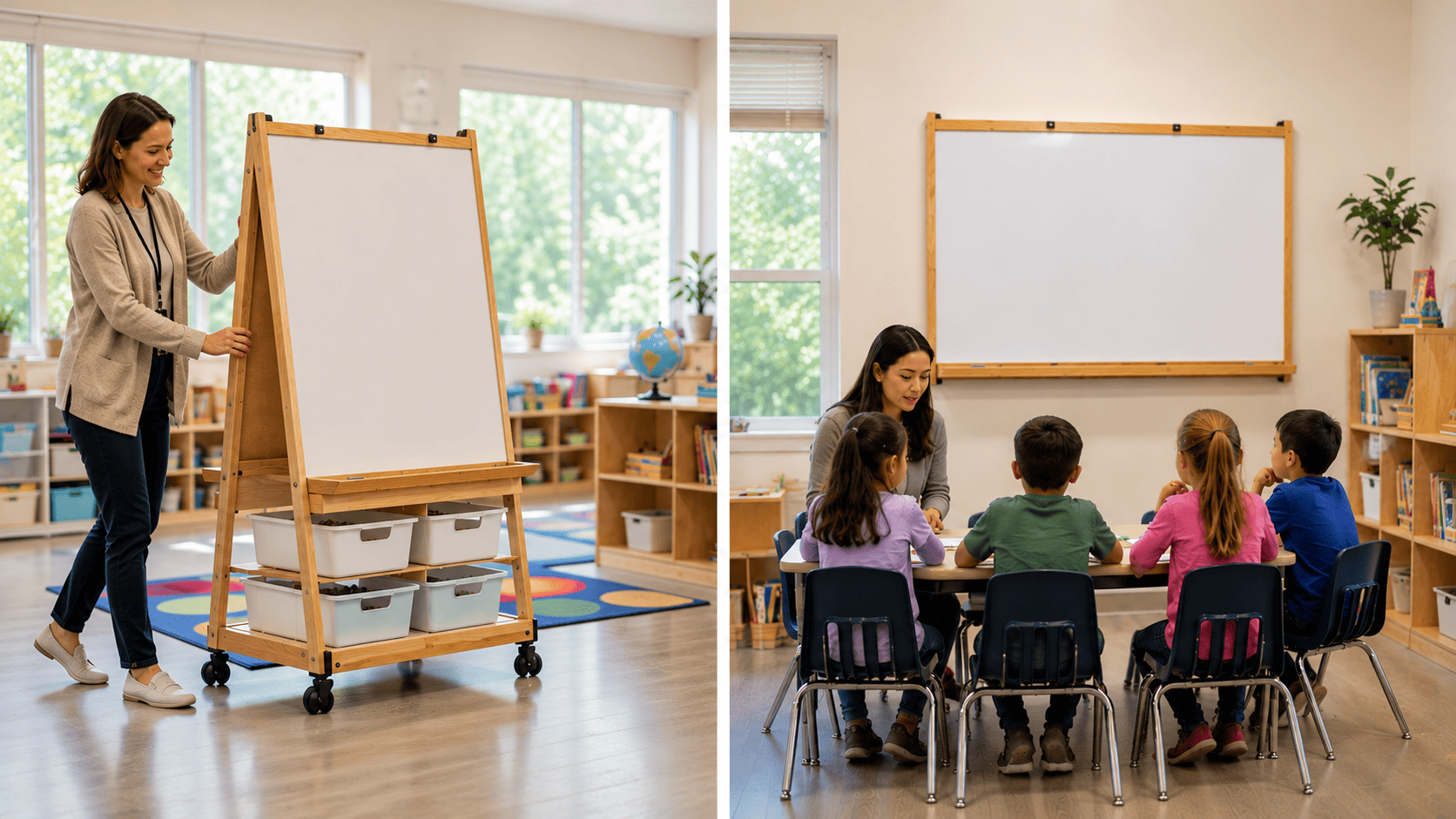
The mobile vs wall-mounted easel for classroom questions sounds like it is about furniture. It is really about how your room breathes across a day. Does your teaching move, or does it stay in one place? Answer that honestly, and the choice mostly makes itself.
Both styles work perfectly fine, but they cause annoying little issues when they end up in the wrong classroom. Putting a wall-mounted board in a space that needs a flexible setup restricts the whole lesson to one wall. On the flip side, a rolling easel in a room where nothing ever changes just eats up floor space that a fixed board would have saved. It's just a waste of space because it's in the wrong room.
This guide breaks the decision down the way it actually plays out: what each type is genuinely good at, the hidden costs on both sides, the room situations that point clearly one way or the other, and the practical details, mounting height, flooring, safety clearance, that decide whether your pick works once it is in place.
The short version, if you only read one thing
If a teacher moves across different spots during the day, get a mobile board. If they stay in one place and floor space is tight, bolt it to the wall. Everything else here is just unusual exceptions and blind spots, but that rule covers most rooms.
What a mobile easel is genuinely good at
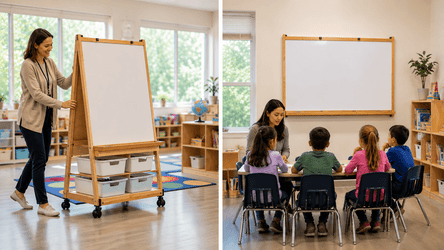
A mobile easel rides on locking casters, so the board travels to the lesson instead of forcing the lesson to gather at one wall. In an active elementary room, that flexibility is not a luxury. It is the whole point.
Picture a normal morning. If class goes from a meeting on the rug to table work to a reading group by the window, a rolling board moves with the lesson. This is where the portable vs fixed classroom easels decision earns its keep, because a portable board turns one piece of furniture into a tool that shows up wherever teaching is happening that period.
The strengths that matter day to day
- ●It follows small-group instruction. Pull a group anywhere in the room, and the board comes too, prepped and ready.
- ●It's shared across rooms. One board can serve two or three classrooms on a rotation, which stretches a tight furniture budget.
- ●It repositions for sightlines. Glare from a window, a student who needs to sit closer, a rearranged room. A mobile board adjusts in seconds.
- ●It clears out when not needed. Roll it to the side during a test or an activity that needs floor space.
There is a catch that the teacher easels buying process should always check, and it is flooring. Small wheels struggle on thick carpet or catch on floor strips. The 3-inch wheels on Copernicus boards handle normal classroom carpet, but you need to check doorway thresholds before buying if the board changes rooms.
What a wall-mounted easel is genuinely good at
Wall-mounted boards free up floor space in tight classrooms. Because they sit on the wall, they never block the path between the door and the rug.
Small rooms and crowded offices cannot waste floor space. The board stays in one position, meaning zero daily adjustment. If a room only uses one teaching spot, there is no practical reason to move the board.
Where fixed genuinely wins
- ●Tight rooms. Every square foot counts, and a wall board frees the floor that a rolling base would occupy.
- ●One teaching spot. If instruction always happens at the same wall, mobility solves a problem the room does not have.
- ●High traffic shared spaces. A hallway nook or shared common area stays clear of a rolling obstacle.
- ●Rooms where a rolling base is a trip risk. Some early years and special education settings are safer without wheeled furniture in the mix.
The honest classroom easel comparison, cost and upkeep included
Most guides stop at movement versus floor space. A real classroom easel comparison has to include the parts nobody puts on the purchase order: what each option costs you over time, and what it asks of you to keep working. Here is the fuller picture.
| Factor | Mobile easel | Wall-mounted easel |
|---|---|---|
| Floor space | Occupies a footprint plus room to maneuver | Frees the floor entirely |
| Flexibility | Moves to any teaching spot or room | Fixed to one location |
| Setup cost | Ready to use out of the box | Needs mounting hardware and installation time |
| Ongoing upkeep | Caster wear, occasional wheel cleaning | Essentially none once mounted |
| Moving it later | Roll it anywhere in seconds | Unmount, patch wall, remount elsewhere |
| Best room type | Active rooms with changing setup | Tight rooms with one teaching zone |
Two lines in that table deserve a second look. The setup cost for wall-mounted is real: someone has to mount it, level it, and anchor it into the right part of the wall, which is a task, not a five-minute job. And the ongoing upkeep on mobile is small but real: casters collect carpet fibers and wear over years of daily use. When schools weigh portable vs fixed classroom easels purely on the sticker price, these are the two costs that surprise them later. Neither is a dealbreaker, but both belong in the decision.
Which classroom easel is better for your specific room
There is no universal winner, and any guide claiming one is selling something. The useful question is not which classroom easel is better in the abstract, but which one fits the room you actually have. So walk your own room through these situations and find the one that sounds like yours.
Choose mobile if your room looks like this
You teach in more than one spot. Your layout changes through the week. You share a board across classrooms or grade levels. You rearrange for different activities. You want the freedom to chase good sightlines or dodge window glare. If two or more of those ring true, a rolling board is your answer, and knowing which classroom easel is better for you was really just noticing that your teaching moves.
Choose wall-mounted if your room looks like this
Instruction always happens at the same wall. Floor space is genuinely tight. The room is a dedicated intervention or specialist space with one teaching zone. A rolling base would be a trip hazard or a traffic problem. When those describe your room, fixed is not the compromise choice. It is the right one, and the mobile vs wall-mounted easel for classroom debate ends up being far less agonizing than it first appears once the room itself has spoken.
A five-second test
Count the spots you teach from in a normal day. One spot points to wall-mounted. Two or more points to mobile. It really is close to that simple, and the rest of the details just confirm the direction that count already gave you.
If you go wall-mounted, get the height right
This is the part schools most often get wrong, and it is worth its own section because a wall board at the wrong height quietly excludes the students who need it most.
For a standard four-foot-tall board, the common guidance is to mount the bottom edge around 34 to 36 inches above the finished floor, which puts the writing surface within comfortable reach and view for most elementary students. Note that ADA guidance does not set a specific rule for non-sliding whiteboards, and the signage rule that centers things at 60 inches actually places a board too high for many young students to reach or read. Lower is usually better in an elementary room.
| Board height | Suggested bottom edge above floor | Best for |
|---|---|---|
| 4-foot board | 34 to 36 inches | General elementary classrooms |
| Lower mount | Around 30 inches | Early years and seated rug instruction |
| Standard adult | Center near 54 inches | Rooms used mainly by staff or older students |
Safety and floor clearance, whichever you choose
A quick but important stretch that applies to both options, because an easel that creates a hazard is a problem no feature list warns you about.
For a mobile board, leave a clear travel path between its parking spot and the places it needs to reach, and confirm that path stays clear of bags, cords, and chair legs. For a wall board, keep the floor in front of it clear so a student using a wheelchair or a walker can get close enough to use it. Good school furniture planning treats that clearance as part of the layout, not an afterthought, which is exactly the kind of thing our team checks when a school sends over a room plan.
Send us your room, and we will tell you which one fits. Share your grade level, your floor plan, and how you teach on a daily basis. Our Project Team maps it and recommends mobile or wall-mounted before you order. Free, no purchase required. Call 877-909-9910.
Get Free Classroom Layout HelpFrequently asked questions
Can a wall-mounted easel hold the same weight of materials as a mobile one?
It depends on the wall and the mounting hardware, not the board itself. A mobile easel carries its load on its own frame and base, so weight is rarely a concern, and it's why teaching easels with tub storage are built as mobile units. A wall-mounted board transfers all of that weight into the wall anchors, which means the type of wall matters. Solid masonry or a properly located stud handles it easily, while a hollow drywall section without backing may need special anchors or a different mounting spot. For units that need to carry loaded tubs and materials, a mobile easel on locking casters avoids the wall-anchor question entirely while still keeping supplies within reach.
Do mobile easels lock firmly enough that students cannot push them around?
Quality mobile easels use locking casters that hold the board firmly in place once engaged, so a student leaning on it or writing at it will not send it rolling. The important habit is actually locking them, since an unlocked caster defeats the purpose. In early learning classrooms, it is worth teaching students that the board stays put only when the wheels are locked, the same way you would with any wheeled classroom furniture.
What happens to a wall-mounted easel if we rearrange or move classrooms?
This is the real long-term cost of going fixed. A wall-mounted board does not come with you easily. Moving it means unmounting the unit, patching and often repainting the wall, and remounting it in the new spot, which is a maintenance job rather than a quick change. Schools that reconfigure rooms often, or that move teachers between classrooms year to year, tend to find a mobile board saves them this hassle repeatedly.
Is one option better for reducing classroom noise or distraction?
A fixed board adds no moving parts and no rolling sound, which some teachers in very small or sound-sensitive rooms prefer. A mobile board does make a soft rolling noise when moved, though it is brief and only during transitions. Neither is loud. If noise is a genuine concern in your specific setting, such as a testing room or a sensory-sensitive space, the fixed option removes even that small movement, which is a small but major point in its favor.
Can we start with a mobile easel and add wall-mounted ones later, or mix both?
Yes, and many schools do exactly that. A mixed setup, mobile boards in flexible general classrooms and wall-mounted boards in fixed intervention rooms, is common and sensible, since it matches each room to what it actually needs rather than forcing one choice across the whole building. There is no requirement to standardize on one type, and matching each room individually usually gives better daily use than a one-size-fits-all order.
Keep reading
This decision is one piece of the larger easel picture. These guides cover the rest.
- ●Teacher Easels for the Modern Classroom. The complete buying guide covering every easel type, size, and price, and the parent guide this article belongs to.
- ●Why Your Classroom Easel Sits Unused. What happens after the easel arrives, and how to make sure it does not end up ignored in a corner.
- ●Chart Stands vs Whiteboard Easels for Anchor Charts. When your real need is holding charts rather than a movable writing surface.
Browse the full teacher easels range, including mobile, dry-erase board, and adjustable options, at Today's Classroom.
Not Sure Which One Fits Your Room?
Send us your grade level, floor plan, and teaching style. We will recommend mobile or wall-mounted before you order. School purchase orders accepted.